
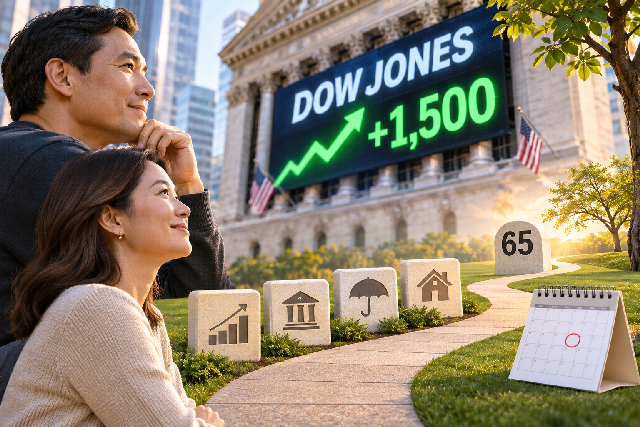
The Dow Jones Industrial Average jumped more than 1,500 points on November 4, 2026, delivering one of its biggest sessions in years. For investors, the important question is not whether the rally was exciting. It is whether a one-day surge should change what you do with your money.
The Dow closed at 53,356.12, up 1,569.40 points, or about 3%. The S&P 500 gained 1.6% to 7,688.62, while the Nasdaq Composite rose 1.4% to 25,736.51. Reuters described the Dow’s move as its strongest session since April 2025.
The rally followed Democrats winning control of both chambers of Congress in the 2026 midterm elections. Falling oil prices also supported market sentiment. But investors should be careful about assigning a single cause to any market move. Elections, interest-rate expectations, energy prices, corporate earnings, positioning and investor psychology can all move stocks at the same time.
Instead of trying to predict what happens tomorrow, long-term investors can use the rally as a reason to review allocation, diversification and taxes.
What Actually Happened to the Dow Jones?
The headline number sounds enormous: more than 1,500 Dow points in one day. But the percentage move gives better context. A 1,569-point gain represented roughly a 3% increase because the Dow was already above 50,000.
| Index | November 4, 2026 Close | Daily Move |
|---|---|---|
| Dow Jones Industrial Average | 53,356.12 | +1,569.40 points, about +3.0% |
| S&P 500 | 7,688.62 | +119.70 points, about +1.6% |
| Nasdaq Composite | 25,736.51 | +364.50 points, about +1.4% |
The differences matter. A 3% Dow gain does not mean every U.S. stock gained 3%.
Why the Dow, S&P 500 and Nasdaq Can Move Differently
The Dow contains only 30 large U.S. companies and is price-weighted. That means stocks with higher share prices can have more influence on the index.
The S&P 500 includes roughly 500 large U.S. companies and weights them primarily by market capitalization. Because it covers far more companies, many investors consider it a better snapshot of the broad large-cap U.S. stock market.
The Nasdaq Composite includes thousands of Nasdaq-listed securities and has heavy exposure to technology and growth companies.
On November 4, the market also showed major sector differences. Reuters reported that nine of the S&P 500’s 11 sectors rose. Consumer discretionary stocks gained more than 4%, while the energy sector fell nearly 5%. Semiconductor shares were also weak, and some companies tied to data-center construction fell sharply.
That divergence is a useful reminder: a strong index headline can hide losses in individual sectors and stocks.
Why Stocks Rallied After the Election
Associated Press reported that Democrats won both the House and Senate in the November 2026 midterms, ending unified Republican control of Congress.
Markets appeared to react partly to greater political certainty and expectations of divided government. Reuters also reported that investors viewed the new balance of power as potentially reducing the probability of major policy changes.
Oil was another important factor. Brent and West Texas Intermediate crude futures fell about 8% on November 4. By that point in the week, Reuters reported that Brent had fallen nearly 20% and WTI about 15%.
Lower energy prices can reduce inflation pressure and lower costs for consumers and many businesses. Still, investors should not assume that either the election or oil prices alone caused the stock-market rally. Markets respond to many expectations simultaneously, and those expectations can reverse quickly.
Should You Buy Stocks After a 1,500-Point Dow Rally?
If you were already planning to invest for retirement or another goal many years away, a one-day rally usually is not a strong reason to abandon that plan.
The bigger risk is making an emotional timing decision: refusing to invest because stocks just rose, then waiting for a pullback that may not happen when you expect it.
For someone regularly contributing to a 401(k), IRA or diversified brokerage portfolio, continuing scheduled investments may be simpler than attempting to forecast the next market move.
That does not mean buying aggressively after every rally. Your decision should depend on your target allocation, time horizon and need for the money.
Four Choices Investors Can Consider
| Choice | Main Benefit | Main Risk | Best Fit |
|---|---|---|---|
| Keep investing normally | Avoids market-timing decisions | You may invest shortly before a decline | Long-term investors following a regular plan |
| Rebalance | Restores your intended risk level | May trigger taxes or trading costs | Portfolio has materially moved away from target |
| Trim concentrated winners | Reduces single-stock or sector risk | You could sell investments that continue rising | One holding has become an outsized part of the portfolio |
| Do nothing | Avoids unnecessary trading and taxes | Allocation drift may continue | Portfolio remains close to target |
Worked Example: Rebalancing a $100,000 Portfolio
Hypothetical example: Suppose an investor wants a portfolio containing 70% stocks and 30% bonds.
Before a strong market move, the investor has:
- $70,000 in stocks
- $30,000 in bonds
- $100,000 total
After stocks rise faster than bonds, assume the portfolio becomes 74% stocks and 26% bonds while remaining worth $100,000 for simplicity.
The holdings are now:
- $74,000 stocks
- $26,000 bonds
To return to a 70/30 target:
Target stock amount = $100,000 × 70% = $70,000
Target bond amount = $100,000 × 30% = $30,000
The investor therefore needs to reduce stocks by $4,000 and increase bonds by $4,000.
One approach would be to sell $4,000 of stock investments and buy $4,000 of bonds. But selling is not the only option. If the investor is still making regular contributions, future deposits could be directed toward bonds until the allocation moves closer to 70/30.
That approach can be especially useful in a taxable account because it may avoid realizing capital gains.
This example is deliberately simplified. Real portfolios change in total value, different holdings have different tax bases, and investors may use wider rebalancing bands rather than resetting the portfolio every time it moves a few percentage points.

When Rebalancing Makes Sense
A market rally alone is not necessarily a reason to rebalance. What matters is whether your allocation has moved far enough to change the amount of risk you are taking.
Some investors review their portfolios on a schedule, such as once or twice per year. Others rebalance when an asset class moves beyond a chosen range around its target.
For example, an investor with a 70% stock target might decide beforehand to take action only if stocks rise above 75% or fall below 65%. The exact range is a personal decision, but establishing the rule before markets become volatile can reduce emotional trading.
Watch Taxes Before Selling Winners
Rebalancing inside a 401(k) or traditional IRA generally does not create an immediate capital-gains tax bill. Selling appreciated investments in a regular taxable brokerage account can.
Under IRS rules, investments held for more than one year generally qualify for long-term capital-gains treatment, while gains on assets held for one year or less are generally treated as short-term gains and taxed at ordinary-income rates.
For tax year 2026, the IRS lists the top of the 0% long-term capital-gains bracket at $49,450 of taxable income for most single filers and $98,900 for married couples filing jointly. The 15% bracket extends to $545,500 for most single filers and $613,700 for married couples filing jointly. Higher taxable income can push gains into the 20% federal rate, and additional taxes may apply in some situations.
Because tax consequences depend on your income, holding period, cost basis and state of residence, check those figures before selling solely to rebalance.
Should You Trim a Stock That Surged?
A broad-market rally can make an existing concentration problem worse.
Imagine one technology stock originally represented 8% of your portfolio but has grown to 20% after several years of strong performance. The decision is no longer simply whether that company will keep rising. The question is whether you are comfortable having one company determine such a large portion of your financial outcome.
Trimming can reduce concentration risk, even if you remain optimistic about the company. The trade-off is that selling may create taxes and could reduce future gains if the stock continues climbing.
What Long-Term Investors Should Do After a Big Market Day
Before making a trade because of the Dow’s 1,500-point jump, run through this checklist:
- Check your target allocation. Compare today’s stock and bond percentages with your long-term plan.
- Look for concentration. See whether one stock, industry or theme has become unusually large.
- Review your time horizon. Money needed within a few years should generally not depend heavily on short-term stock performance.
- Check taxes before selling. Review cost basis and holding periods in taxable accounts.
- Use new contributions strategically. You may be able to rebalance by directing new money toward underweight investments.
- Avoid chasing headlines. A large gain today does not guarantee another gain tomorrow.
- Do not change a sound plan solely because of politics. Election outcomes matter, but they are only one of many forces affecting markets.
FAQ
Is a 1,500-point Dow gain unusually large?
Yes. On November 4, 2026, the Dow rose 1,569.40 points, or about 3%, and Reuters reported that it was the index’s strongest session since April 2025. Percentage changes are generally more useful than point changes when comparing market moves across different periods.
Does a Dow rally mean I should buy immediately?
Not necessarily. A long-term investor who is already contributing regularly may have little reason to change course. Someone whose portfolio has become too conservative could have a reason to buy stocks, while someone whose stock allocation is already above target may need the opposite trade.
Should I sell because stocks have risen quickly?
A rapid rise by itself is not a reliable sell signal. Selling can make sense when it restores your desired asset allocation, reduces excessive concentration, raises cash needed for a near-term goal or fits another predetermined part of your financial plan.
Could the market reverse after the post-election rally?
Yes. One-day rallies can be followed by additional gains, flat markets or sharp declines. Investors cannot know in advance which path will occur. That uncertainty is one reason allocation and diversification tend to be more useful long-term tools than reacting to individual trading sessions.
The Bottom Line
The Dow’s 1,569-point surge on November 4 was dramatic, but the headline itself does not tell you what to buy or sell.
For most long-term investors, the more useful response is to compare the portfolio they own with the portfolio they intended to own. If the two are still close, doing nothing may be reasonable. If stocks have pushed your allocation materially above target, rebalancing can reduce risk. If individual winners have become dangerously concentrated, trimming them may improve diversification.
The best decision is usually based on allocation, taxes, diversification and time horizon—not on whether tomorrow’s Dow headline is green or red.
References
- Reuters — Wall Street ends higher after Democrats win Congress; data center stocks tumble. Supports the November 4 closing levels for the Dow, S&P 500 and Nasdaq, as well as sector performance and market reaction.
- Reuters — Trading Day: Oil tanks, stocks leap on U.S. midterms. Supports the Dow’s strongest-session comparison, the November 4 oil decline and the week’s broader drop in Brent and WTI crude.
- Associated Press — Democrats win the U.S. House and Senate. Supports the confirmed outcome of the 2026 congressional midterm elections.
- Reuters — AI data-center stocks slide, renewables rally after Democratic U.S. midterm sweep. Supports the discussion of sector divergence and weakness among data-center-related stocks.
- Internal Revenue Service — Revenue Procedure 2025-32, 2026 inflation-adjusted tax items. Supports the 2026 long-term capital-gains income thresholds.
- Internal Revenue Service — Topic No. 409, Capital Gains and Losses. Supports the distinction between short-term and long-term capital gains and general federal tax treatment of investment sales.