
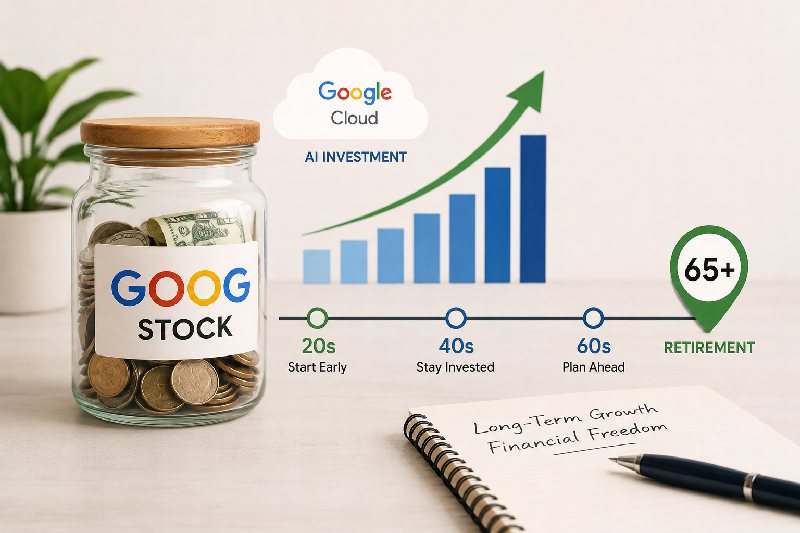
Alphabet, Google’s parent company, delivered another quarter of strong financial results. Revenue and earnings exceeded many analysts’ expectations, and Google Cloud continued to grow rapidly. Yet the market reaction surprised many investors: GOOG stock declined after management announced plans to significantly increase capital spending on artificial intelligence infrastructure.
For long-term investors, this raises an important question. Is the stock decline a warning sign, or is it simply the market reacting to higher near-term costs while overlooking future opportunities?
This guide explains what happened, why investors reacted negatively despite strong earnings, and how individual investors can evaluate whether GOOG still fits their portfolios.
What Changed?
Alphabet reported quarterly earnings that exceeded Wall Street expectations in several important areas. Revenue continued to grow, profitability remained healthy, and Google Cloud delivered another impressive quarter as businesses increased spending on AI-powered cloud services.
However, management also announced higher capital expenditure plans for 2026. Much of this spending will fund:
- AI data centers
- Advanced chips and servers
- Networking infrastructure
- Expansion of Google Cloud capacity
- Large language model development
While investors generally support AI investments, markets often react negatively when spending increases faster than expected because higher expenses can reduce near-term earnings and free cash flow.
Why Did GOOG Stock Fall After Good Earnings?
Many new investors assume that strong earnings automatically cause a stock to rise. In reality, stock prices depend on future expectations rather than past performance.
Investors were already expecting strong quarterly results. The bigger surprise came from Alphabet’s willingness to spend even more on AI infrastructure over the coming years.
The market asked one simple question:
Will today’s larger investment generate enough future profits to justify the higher spending?
That uncertainty caused many traders to sell shares despite the strong earnings report.
Why AI Spending Matters
Artificial intelligence has become one of the largest technology investment themes in decades.
Alphabet is competing directly with companies including Microsoft, Amazon, Meta, OpenAI, Anthropic, and numerous cloud providers.
To remain competitive, Alphabet must continue investing heavily in:
- Data centers
- AI chips
- Cloud infrastructure
- Gemini AI models
- Search improvements
These investments reduce current profits but may increase future revenue if customers adopt more AI services.
What Google Cloud Means for Investors
One of the most encouraging parts of Alphabet’s earnings report was continued strength in Google Cloud.
Cloud computing has become one of Alphabet’s fastest-growing businesses.
Businesses increasingly rent computing power instead of owning servers, while AI applications require enormous computing resources.
If Google Cloud continues growing, it could become an even larger contributor to Alphabet’s profits over the next decade.
How This Affects Individual Investors
Most Americans own Alphabet even if they have never purchased GOOG shares directly.
You may already have exposure through:
- S&P 500 index funds
- Total stock market ETFs
- 401(k) retirement plans
- IRA accounts
- Target-date retirement funds
That means Alphabet’s performance can influence retirement savings without investors realizing it.
Potential Benefits vs. Risks
| Potential Benefits | Potential Risks |
|---|---|
| Continued AI leadership | Higher capital spending reduces short-term profits |
| Growing Google Cloud business | Intense competition in AI |
| Large cash reserves | Slower advertising growth |
| Diversified revenue sources | Regulatory pressure |
| Strong balance sheet | Higher investor expectations |
Questions Investors Should Ask
Instead of reacting emotionally to a single day’s stock movement, consider these questions:
- Has Alphabet’s long-term business changed?
- Will AI investments likely generate higher future revenue?
- Does the company still produce strong cash flow?
- Has the stock become more attractive after the decline?
- Does GOOG still fit my investment goals?
Answering these questions is generally more useful than trying to predict tomorrow’s stock price.
Example Scenarios
Example 1: Retirement Investor
Emily owns only an S&P 500 ETF inside her 401(k).
Because Alphabet represents part of the index, one day’s stock decline has only a limited impact on her retirement portfolio.
Rather than making emotional decisions, she continues investing through regular payroll contributions.
Example 2: Individual Stock Investor
James owns only GOOG shares.
He reviews the earnings report to determine whether higher AI spending changes the long-term investment case.
If he still believes Alphabet will grow over many years, a temporary decline may not justify selling.
Example 3: New Investor
Maria has been waiting to buy GOOG.
Instead of investing all of her cash immediately, she considers dollar-cost averaging by purchasing shares gradually over several months.
This reduces the risk of investing all her money immediately before additional market volatility.
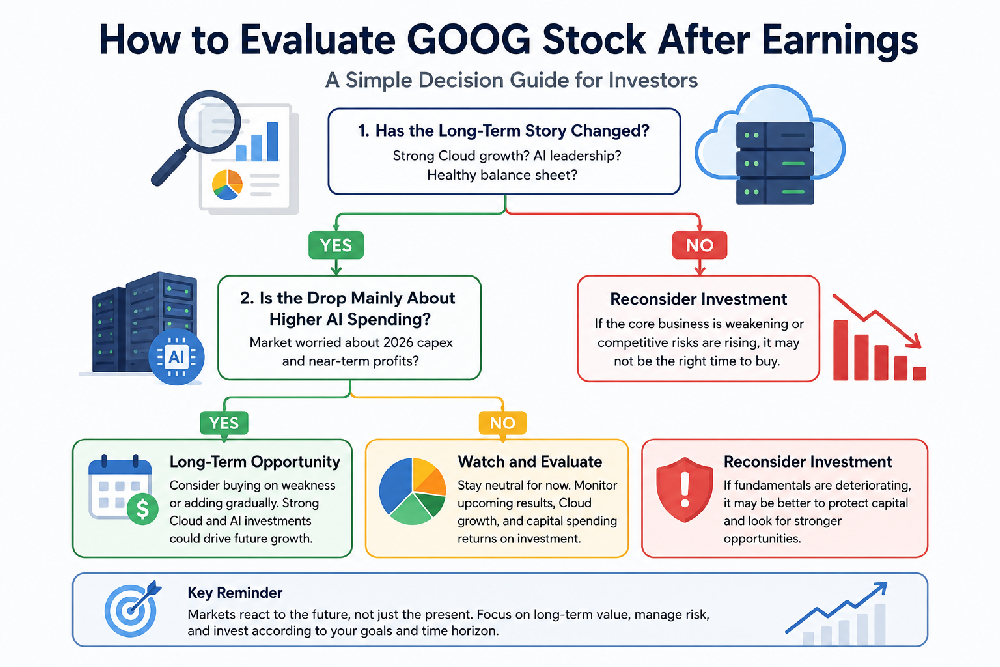
Decision Framework
| If You Are… | Questions to Consider |
|---|---|
| Long-term investor | Has the long-term growth story changed? |
| Retirement saver | Is GOOG only one part of a diversified portfolio? |
| New buyer | Would gradual investing reduce timing risk? |
| Short-term trader | Can you tolerate continued volatility around AI spending? |
Simple Investment Calculators
Portfolio Exposure
Formula
Portfolio Exposure = Portfolio Value × GOOG Allocation
Example
$150,000 × 4% = $6,000 invested in Alphabet.
Dollar-Cost Averaging
Formula
Monthly Investment = Total Planned Investment ÷ Number of Months
Example
$12,000 ÷ 12 = $1,000 invested each month.
Gain or Loss Percentage
Formula
((Current Price − Purchase Price) ÷ Purchase Price) × 100
This calculation helps investors measure investment performance over time.
Common Mistakes to Avoid
- Assuming good earnings always mean higher stock prices.
- Buying or selling based only on headlines.
- Ignoring long-term capital spending plans.
- Overreacting to one day’s market movement.
- Owning too much of a single company.
Should Investors Be Concerned?
Higher capital spending is not automatically bad news.
Technology companies often invest aggressively during periods of innovation. Amazon, Microsoft, and Meta have all increased infrastructure spending during major technology transitions.
The important question is whether these investments eventually generate higher earnings.
If Alphabet successfully expands its AI products, strengthens Google Cloud, and maintains leadership in digital advertising, today’s spending could support future growth.
On the other hand, if AI investments fail to produce meaningful returns, investors may eventually question whether the increased spending was justified.
Frequently Asked Questions
Why did GOOG stock fall after strong earnings?
Investors focused on Alphabet’s increased AI capital spending rather than the strong quarterly results. Markets often react to future expectations more than current earnings.
Is GOOG the same as GOOGL?
They represent different share classes of Alphabet. The primary difference involves voting rights rather than ownership of the underlying business.
Should long-term investors panic?
Not necessarily. Long-term investors usually evaluate whether the company’s competitive position and future earnings potential have changed rather than reacting to one trading session.
Does higher AI spending automatically reduce future returns?
No. Higher spending reduces current profits, but successful investments may generate larger revenue and earnings over many years.
Does this affect index fund investors?
Yes, but usually only to the extent that Alphabet represents a portion of the fund. Diversified funds spread risk across hundreds of companies.
Final Thoughts
The recent decline in GOOG stock illustrates an important investing lesson: markets care about future expectations as much as current results. Alphabet continues to benefit from strong advertising revenue, expanding cloud services, and significant AI opportunities, but investors are carefully weighing whether the company’s higher infrastructure spending will produce adequate long-term returns.
For most individual investors, the better approach is to evaluate long-term fundamentals instead of reacting to daily price swings. Reviewing diversification, investment goals, and risk tolerance generally leads to better decisions than trying to predict short-term market movements.
References
- Alphabet Investor Relations — Official earnings releases, shareholder letters, earnings calls, and financial results supporting Alphabet’s reported performance and capital expenditure plans.
- U.S. Securities and Exchange Commission (EDGAR) — Official SEC filings, including Forms 10-Q and 10-K, supporting financial statements and risk disclosures.
- Nasdaq GOOG Stock Information — Market data, historical prices, and trading information for GOOG shares.
- Investor.gov — U.S. SEC educational resource explaining diversification, long-term investing, and investment risk.
- S&P Dow Jones Indices — Information about the S&P 500 index and why companies like Alphabet influence many retirement and index fund portfolios.