
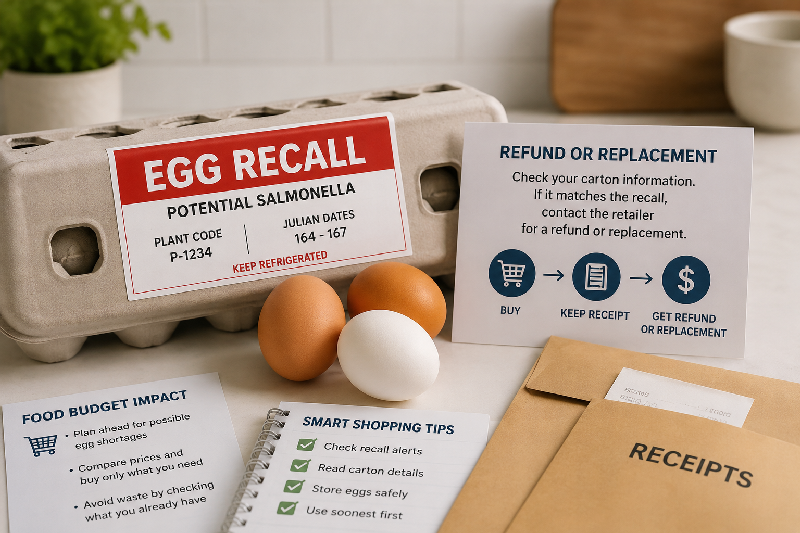
A large egg recall announced in July 2026 affects nearly 1.6 million dozen eggs sold under several brand names. The recalled cartons may be contaminated with Salmonella Enteritidis, a bacterium that can cause serious foodborne illness.
The recall does not mean that every egg in every supermarket is unsafe. It applies only to specific products carrying certain plant codes and date codes. Checking those details before throwing anything away can protect your health while also preventing unnecessary food waste.
For shoppers, the main financial question is simple: Should you discard the eggs, return them for a refund, or keep them? The answer depends on the information printed on the carton.
What Changed in the July 2026 Egg Recall?
Midwest Poultry Services, L.P. voluntarily recalled 1,589,577 dozen white shell eggs and brown cage-free eggs produced at farms in Texas. That equals more than 19 million individual eggs.
The affected eggs were produced and distributed between June 6 and July 3, 2026. Their sell-by or best-by dates range from July 20 through August 17, 2026. The FDA posted the company announcement on July 22, 2026. :contentReference[oaicite:0]{index=0}
The eggs were sent to retail and food-service customers in Texas, Oklahoma, and Louisiana. Consumer packages were also sold through:
- Kroger stores in Texas and Louisiana
- Brookshire Grocery stores in Texas, Oklahoma, Arkansas, Louisiana, New Mexico, and Mississippi
- Smaller retail outlets in the affected region
Midwest Poultry Services said it discovered the issue through environmental monitoring and a review of the possible cause. The company stopped distributing fresh eggs produced at its Texas farms while addressing the situation.
As of the recall announcement, the company said it was not aware of any specific illnesses linked to these eggs. That does not make recalled cartons safe to eat. A recall based on possible contamination should still be taken seriously.
How to Tell Whether Your Eggs Are Recalled
Do not rely on the brand name alone. Some brands included in the recall may also sell eggs produced at other facilities that are not affected.
Look on the side of the carton for a plant number and a three-digit Julian date. The FDA notice says the recalled products carry one of these identifying codes:
- P-1950
- 0840962 or 840962
The carton must also have a Julian date from 157 through 184. These numbers represent production dates rather than normal calendar dates.
| What to check | Recalled information |
|---|---|
| Plant or identifying code | P-1950, 0840962, or 840962 |
| Julian date | 157 through 184 |
| Sell-by or best-by period | July 20 through August 17, 2026 |
| Product types | Selected white shell eggs and brown cage-free eggs |
| Important rule | The brand, code, and date information must match the recall notice |
A carton with a listed brand but a different plant code is not automatically included. Likewise, a matching plant code outside the recalled Julian-date range may not be part of this recall. Compare all available information with the current FDA product list.
Which Egg Brands and Package Sizes Are Included?
The recall covers multiple package sizes sold under Kroger, Simple Truth, Brookshire’s, Country Morning, and Sunups branding. It also includes certain bulk egg packages supplied to food-service businesses.
Examples listed by the FDA include:
- Kroger medium, large, extra-large, and jumbo eggs
- Kroger cartons containing 12, 18, 30, or 60 eggs
- Simple Truth cage-free brown eggs in 12-, 18-, and 24-count packages
- Brookshire’s eggs in several sizes and package counts
- Country Morning medium, large, extra-large, and jumbo eggs
- Sunups medium eggs in 2.5-dozen packages
This is not the complete product list. Because package sizes and UPC numbers vary, shoppers should use the FDA recall page as the final authority rather than relying only on a news headline or social media post.
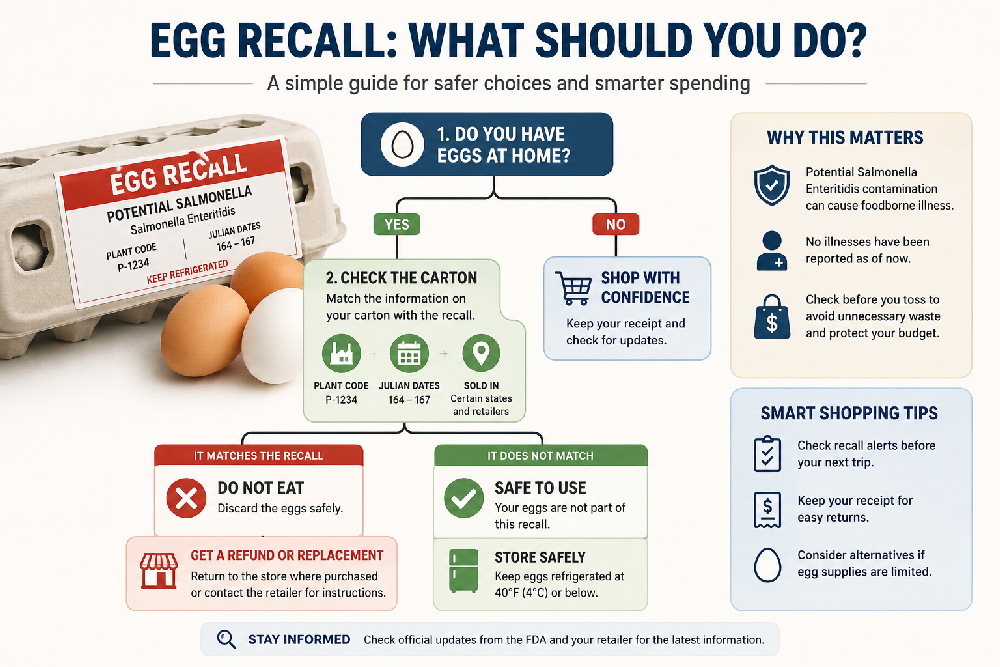
What Should You Do With Recalled Eggs?
Do not eat eggs that match the recalled plant and date codes. Cooking can reduce many food-safety risks, but consumers should not try to make a recalled product safe by cooking it longer.
The company advises customers to return affected eggs to the original place of purchase for a full refund. This is usually the best financial option because it removes the unsafe product without forcing you to absorb the full cost.
- Place the carton in a bag so it does not contact other food.
- Take a clear photo of the carton, codes, and receipt if available.
- Contact or visit the store to ask about its recall-return procedure.
- Request a refund or replacement.
- Clean refrigerator shelves and other surfaces that touched the carton or eggs.
FoodSafety.gov notes that recall instructions commonly direct consumers either to return the food for a refund or dispose of it where people and animals cannot eat it. :contentReference[oaicite:1]{index=1}
Do not give recalled eggs to neighbors, pets, food pantries, or backyard animals. If a store return is not practical, seal the eggs securely before putting them in the trash.
How the Egg Recall Can Affect Your Grocery Budget
A recalled carton may seem like a small expense, but the loss can add up for larger households, restaurants, day-care providers, and shoppers who bought eggs in bulk.
Suppose a family bought two 18-count cartons for $5.50 each. Discarding both without requesting a refund would create an $11 loss. Replacing them immediately with eggs costing $6.25 per carton would require another $12.50.
The family’s temporary cash outlay would be:
$11 already spent + $12.50 for replacements = $23.50
If the store refunds the original $11, the family’s final cost returns to the normal replacement cost of $12.50. That is why saving the package and checking the retailer’s policy matters.
To limit the budget impact:
- Return qualifying products instead of automatically throwing them away.
- Do not replace unaffected eggs merely because they share a brand name.
- Compare the unit price per dozen when buying a replacement carton.
- Avoid panic-buying more eggs than your household can use.
- Use other affordable proteins temporarily if local egg prices rise.
Beans, lentils, peanut butter, canned tuna, yogurt, tofu, and lower-priced cuts of poultry may replace eggs in some meals. For baking, the right substitute depends on whether the egg provides moisture, structure, or leavening.
Could the Recall Raise Egg Prices?
A recall can temporarily reduce the number of eggs available in affected stores. However, one recall does not guarantee a major nationwide price increase.
The effect on your local price will depend on how quickly retailers obtain eggs from other suppliers, how much inventory was removed, transportation costs, and broader market conditions. A store with several suppliers may restock quickly. A smaller retailer may have fewer alternatives.
Consumers should compare prices rather than assume every carton is now scarce. Buying an oversized package at a high price can waste more money if the eggs expire before they are used.
How to Clean Your Refrigerator Safely
If recalled eggs leaked or touched refrigerator surfaces, wash the affected area with hot, soapy water. Also clean containers, drawers, utensils, and reusable bags that may have contacted the eggs.
The CDC advises washing and sanitizing items and surfaces that may have touched recalled eggs. Hands should also be washed after handling the carton. :contentReference[oaicite:2]{index=2}
Keep raw eggs away from foods that will be eaten without further cooking. Do not wash eggs before storing them, since splashing water may spread bacteria around the sink and nearby surfaces.
Salmonella Symptoms to Watch For
Common Salmonella symptoms include diarrhea, fever, and stomach cramps. Some people may also experience nausea, vomiting, headache, or loss of appetite.
Symptoms usually begin between six hours and six days after exposure. Most people recover within four to seven days without special treatment, but illness can become severe. :contentReference[oaicite:3]{index=3}
Young children, adults age 65 and older, and people with weakened immune systems face a higher risk of serious complications.
Contact a healthcare provider when symptoms are severe, such as:
- Bloody diarrhea
- Diarrhea that continues without improvement
- A fever above 102 degrees Fahrenheit
- Vomiting that prevents fluids from staying down
- Signs of dehydration, including dizziness, dry mouth, or reduced urination
Medical costs can be much greater than the price of a carton of eggs. Do not eat a recalled product simply to avoid wasting a few dollars.
A Simple Keep, Return, or Discard Decision
| Situation | Best action |
|---|---|
| Brand, plant code, and Julian date match | Do not eat. Return for a refund or dispose of it safely. |
| Brand matches, but plant code does not | Review the FDA notice carefully; do not assume it is recalled. |
| Carton is missing and identity cannot be confirmed | Contact the retailer or supplier before using the eggs. |
| Eggs were used and someone develops symptoms | Contact a healthcare provider and report the suspected illness. |
| Restaurant or bakery used possible recalled bulk eggs | Contact the business and local health department for guidance. |
Frequently Asked Questions
Are all Kroger eggs recalled?
No. Only specified products with the recalled identifying codes and Julian dates are included. Check the carton rather than discarding every Kroger-branded egg.
Do I need a receipt to receive a refund?
The recall announcement calls for returning the product to the original place of purchase for a full refund, but individual store procedures may differ. Bring the carton and receipt when possible. Contact the store before traveling if you no longer have the receipt.
Can I keep eggs that do not match the recalled codes?
Eggs that do not match the recall information are not included based solely on the brand name. Continue following normal refrigeration, handling, and cooking practices.
Can I freeze recalled eggs instead of returning them?
No. Freezing does not cancel a recall. Return or safely discard affected products as directed.
Have any illnesses been confirmed?
Midwest Poultry Services stated in its July 22 announcement that it was not aware of specific illnesses linked to its products at that time. Recall information can change, so check the FDA and CDC for updates.
Who can answer questions about the recall?
The FDA notice lists Midwest Poultry Services’ consumer line as 574-405-9531, available Monday through Friday from 8:00 a.m. to 4:30 p.m. Eastern time. It also lists recallassistance@mpseggs.com for consumer questions.
The Bottom Line
The July 2026 egg recall is large, but it is also specific. Do not panic and do not clear every egg from your refrigerator. Check the brand, plant number, Julian date, and best-by or sell-by date.
If all the details match, stop using the eggs and seek a full refund. If they do not match, confirm the information through the FDA before discarding food. This approach protects your household from Salmonella while reducing unnecessary waste and avoiding an avoidable hit to your grocery budget.
References
- U.S. Food and Drug Administration: Midwest Poultry Services Egg Recall — Supports the recall quantity, affected brands, product codes, distribution details, refund guidance, and company contact information.
- FDA Recalls, Market Withdrawals, and Safety Alerts — Provides the official federal listing for current recall announcements and later updates.
- Centers for Disease Control and Prevention: Symptoms of Salmonella Infection — Supports information about symptoms, timing, illness duration, and warning signs.
- FoodSafety.gov: What to Do With a Recalled Product — Supports general instructions for returning, refunding, or safely disposing of recalled food.
- FoodSafety.gov: Salmonella and Eggs — Supports safe egg handling, cooking, and contamination-prevention guidance.