
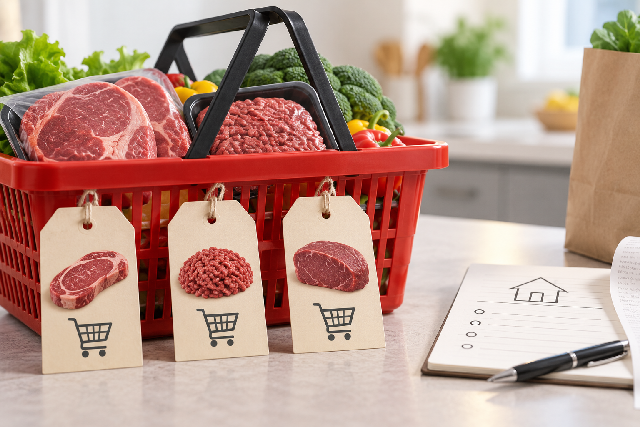
Beef has become one of the more painful items on the grocery receipt, and now federal officials are taking a closer look at how those prices are set.
The U.S. Department of Justice has expanded its beef affordability investigation to include eight major retailers. Reports say letters were sent to Costco, Publix, Aldi, Walmart, Kroger, Albertsons, Ahold Delhaize USA and Amazon as the government examines rising retail beef prices. The broader investigation began with scrutiny of large meatpacking companies. :contentReference[oaicite:0]{index=0}
For shoppers, however, the important question is not simply whether a grocery chain appears in an investigation. It is whether beef prices are likely to change and what households should do with their food budgets in the meantime.
The safest assumption is that there will be no immediate price relief. An investigation can take time, and receiving a request for information does not by itself prove that a retailer broke the law. Meanwhile, several supply pressures that have pushed beef prices higher are still present.
What Changed in the Beef Price Investigation?
The Justice Department’s Antitrust Division has expanded its examination of beef pricing from meat processors further into the retail side of the supply chain. According to reports on the investigation, the government requested information from eight large retailers about matters such as beef pricing, costs, margins and purchasing practices. :contentReference[oaicite:1]{index=1}
This matters because the price shoppers see in a supermarket meat case is the result of several steps. Ranchers raise cattle. Processors turn cattle into packaged beef. Distributors and retailers then move and sell those products. Costs and market conditions at any of these stages can affect the final shelf price.
The government is trying to understand how prices moved through that system and whether competition has been working properly. The Justice Department has also emphasized that its broader meatpacking investigation has not reached a predetermined outcome. :contentReference[oaicite:2]{index=2}
Does the Probe Mean Publix, Costco or Aldi Did Something Wrong?
No. Consumers should be careful about treating an investigation as a finding of misconduct.
A government agency can request records, pricing information and other business data while trying to understand a market. That is different from filing a lawsuit, reaching a settlement or obtaining a court judgment that says a company violated antitrust law.
At this stage, shoppers should view the retailer letters as part of an information-gathering process. The names of familiar stores naturally make headlines, but the existence of the probe does not establish that those companies illegally raised beef prices.
Beef Prices Really Are Much Higher
The frustration behind the investigation is easy to understand. Beef prices have risen much faster than many other grocery categories.
According to the Bureau of Labor Statistics, the Consumer Price Index for beef and veal was 9.4% higher in July 2026 than a year earlier. Ground beef was up 9.0%, uncooked steaks were up 9.6% and beef roasts were up 13.5%. By comparison, overall food-at-home prices were up 2.7% during the same 12-month period. :contentReference[oaicite:3]{index=3}
| Food category | 12-month price change through July 2026 | What it means for shoppers |
|---|---|---|
| Beef and veal | +9.4% | Beef is rising much faster than groceries overall. |
| Ground beef | +9.0% | Even everyday beef meals have become more expensive. |
| Beef roasts | +13.5% | Larger family meals can produce a noticeable budget increase. |
| Beef steaks | +9.6% | Premium cuts are becoming harder to fit into routine budgets. |
| Food at home overall | +2.7% | The beef increase is well above general grocery inflation. |
Why Are Beef Prices So High?
The investigation may examine competitive behavior, but competition is only one possible piece of the price story. The United States is also dealing with tight cattle supplies.
USDA data showed 28.5 million beef cows as of July 1, 2026, down 1% from the previous year. The agency also estimated the 2026 calf crop at 32.5 million head, down 2%. Fewer animals available today can limit how much beef reaches consumers later. :contentReference[oaicite:4]{index=4}
USDA’s Economic Research Service has also reported weaker beef production and high wholesale prices. Its latest 2026 Food Price Outlook forecast beef and veal prices to rise about 9.8% for the year, although actual results can fall above or below forecasts. :contentReference[oaicite:5]{index=5}
That distinction is important for household planning. Even if regulators eventually discover a competition problem, cattle shortages and production constraints would not automatically disappear.
Should Shoppers Expect Beef Prices to Fall Soon?
There is currently no good reason to build your grocery budget around a quick price drop.
An antitrust investigation can lead to several outcomes. Regulators could find insufficient evidence for further action. They could demand changes, negotiate settlements or pursue litigation. Even when enforcement occurs, the effect on supermarket prices may take time and can be difficult to separate from changes in cattle supply, wholesale prices, transportation costs and consumer demand.
Neither the investigation itself nor a letter sent to a retailer is the equivalent of a scheduled price reduction.
For personal finance purposes, a better strategy is to manage today’s prices rather than postponing budget decisions because beef might become cheaper later.
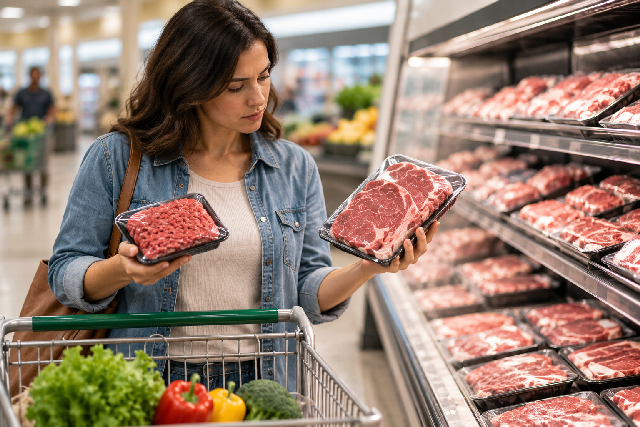
How to Control Your Beef Spending Without Giving It Up
You do not necessarily need to stop buying beef. Small changes in how you shop can reduce the effect of higher prices.
Compare the Price Per Pound
Large packages can look like bargains because the total amount of food is bigger. The useful number is the unit price.
For example, suppose one store sells a 3-pound package of ground beef for $20.97 while another offers a 5-pound package for $31.45.
Price per pound = package price ÷ package weight
The first package costs $6.99 per pound. The second costs $6.29 per pound. Buying the larger package saves 70 cents per pound, or $3.50 across five pounds, assuming your household will actually use or freeze all of it.
A bulk package that goes bad is not a bargain.
Compare Cuts, Not Just Stores
Many shoppers spend time comparing Costco with Aldi or Publix but continue buying exactly the same cut of meat. Changing the cut can sometimes save more than changing the retailer.
Consider less expensive cuts for slow cooking, stews, tacos, casseroles or shredded beef. Watch weekly promotions rather than assuming one chain is always cheapest.
Use Beef as Part of the Meal
A recipe does not always need a full pound of beef per meal. Ground beef can be combined with beans, lentils, vegetables, rice or pasta depending on the dish.
If a household normally uses two pounds for a dinner and reduces that to 1.5 pounds, four similar meals would eliminate two pounds of beef purchases. At $6.50 per pound, that is about $13 saved without removing beef completely.
Compare Alternative Proteins
Beef prices have not moved in the same direction as every other protein. BLS data for July showed poultry prices slightly lower than a year earlier, while pork prices were only modestly higher. :contentReference[oaicite:6]{index=6}
This creates an opportunity to rotate proteins based on current prices instead of following the same weekly menu regardless of cost.
A Simple Beef-Budget Decision Framework
| If you notice… | Consider doing… |
|---|---|
| Your preferred cut jumped sharply in price | Compare another cut before changing stores. |
| A warehouse package has a lower unit price | Buy it only if you can freeze or use the full amount. |
| Beef is pushing your grocery spending over budget | Replace one or two beef meals with lower-cost proteins. |
| A retailer advertises a major beef sale | Compare the sale price per pound with your normal price. |
| You are waiting for the DOJ probe to lower prices | Keep budgeting around current prices until actual reductions appear. |
How Much Can Rising Beef Prices Affect a Family Budget?
The effect depends on how much beef your household buys.
Imagine a family that previously spent $80 per month on beef. A roughly 9% increase would add about $7.20 per month if buying habits remained similar.
That sounds small in isolation, but it equals about $86 over a year. And households are simultaneously paying for dozens of other grocery items, utilities, housing, transportation and insurance.
If your monthly budget is already tight, repeated increases across several categories can reduce the amount available for debt payments or savings. That is why adjusting recurring grocery purchases can matter more than chasing occasional one-time savings.
What the Probe Could Eventually Mean for Consumers
The investigation is worth following because competition affects how markets work. If regulators find evidence of illegal coordination or manipulation, enforcement could potentially change business practices and improve competitive pressure.
But consumers should separate that possibility from the current economic reality. Beef supplies remain tight, and USDA expects production constraints to continue affecting the market. :contentReference[oaicite:7]{index=7}
The useful personal finance takeaway is therefore simple: follow the investigation, but do not make your household budget depend on its outcome.
Frequently Asked Questions
Is the Justice Department investigating Publix, Costco and Aldi over beef prices?
The Justice Department has expanded its beef affordability investigation to eight major retailers, including Publix, Costco and Aldi, along with Walmart, Kroger, Albertsons, Ahold Delhaize USA and Amazon. Reports say the agency requested information related to retail beef pricing and business practices. :contentReference[oaicite:8]{index=8}
Does this mean the grocery stores illegally raised prices?
No. An investigation or information request is not proof of wrongdoing. Regulators still have to examine the evidence and determine whether any laws were violated.
Why is beef so expensive in 2026?
Tight cattle supplies and lower expected beef production are important factors. USDA data also show fewer beef cows than a year earlier and a smaller estimated calf crop, while wholesale prices have remained elevated. :contentReference[oaicite:9]{index=9}
Will the DOJ investigation make beef cheaper?
There is no announced timetable or guarantee that the investigation will reduce retail beef prices. Even if enforcement action eventually changes competitive practices, supply conditions can continue influencing prices.
What is the easiest way to spend less on beef?
Start with unit prices. Compare the price per pound across package sizes and cuts. Then decide whether a cheaper cut, sale item, bulk package or alternative protein offers better value for the meals you actually cook.
Bottom Line
The Publix, Costco and Aldi beef price probe comes at a time when consumers have a legitimate reason to notice what is happening in the meat aisle. Federal data show beef prices rising much faster than overall grocery prices, and the Justice Department wants more information about how prices developed across the industry.
But the investigation should not be confused with a conclusion that any particular retailer did something illegal. It also does not guarantee cheaper steaks or ground beef next month.
For now, households have more control over how they buy beef than over where beef prices go. Comparing unit prices, switching cuts, making good use of bulk purchases and rotating in lower-cost proteins can protect the grocery budget while the government investigation and the cattle market continue to develop.
References
- U.S. Department of Justice — Remarks on Beef and Meatpacking Antitrust Investigations — Provides official DOJ context on the broader meatpacking investigation, market concentration and the department’s statement that it has not prejudged the outcome.
- Reuters — Justice Department Expands Beef Price Probe to Eight Retailers — Reports the September 2026 expansion and identifies the retailers contacted by the Justice Department.
- U.S. Bureau of Labor Statistics — Consumer Price Index Detailed Food Categories — Provides current inflation data for beef, ground beef, steaks, roasts and other grocery categories.
- USDA National Agricultural Statistics Service — July 2026 Cattle Inventory — Provides official figures on U.S. cattle, beef cows and the expected calf crop.
- USDA Economic Research Service — Food Price Outlook — Tracks beef and veal inflation and explains the role of tight cattle supplies, beef production and wholesale prices.