
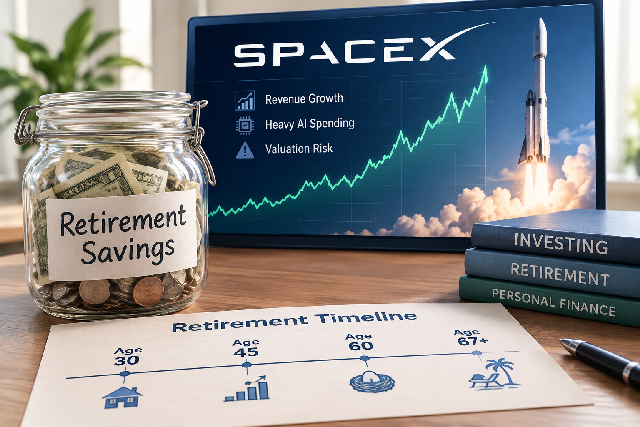
SpaceX stock attracted enormous attention after the company released its first quarterly earnings report as a public company. The numbers showed fast revenue growth, but the stock still fell after the announcement. That may seem confusing to new investors. A company can report better-than-expected sales and still disappoint the market when spending, valuation, or future risks become the bigger story.
For individual investors, the key question is not whether SpaceX is an exciting company. It clearly operates in important and fast-growing markets. The more useful question is whether the stock fits your financial plan at its current price and risk level.
This article explains what changed, why investors reacted negatively, and how to decide whether buying, holding, or waiting makes the most sense for your portfolio.
What Changed in SpaceX’s First Earnings Report?
SpaceX reported approximately $7.8 billion in second-quarter revenue, according to reports covering the company’s first results after its public offering. That represented roughly 92% growth from the same period a year earlier and exceeded Wall Street’s pre-report estimates.
The company also reported a net loss of about $541 million. Although the loss was smaller than some analysts expected, investors focused heavily on the amount of money SpaceX plans to spend on artificial intelligence infrastructure, rockets, satellites, computing capacity, and related expansion projects.
SpaceX stock fell around 7% to 8% in after-hours trading following the report. The decline showed that investors had already priced in very strong growth. When expectations are extremely high, simply beating revenue estimates may not be enough.
| Reported development | Why it matters to investors |
|---|---|
| Revenue rose about 92% year over year | Shows strong demand across SpaceX’s businesses |
| Quarterly revenue reached about $7.8 billion | Exceeded the level many analysts expected |
| The company remained unprofitable on a net-income basis | Raises questions about when growth will produce steady profits |
| Capital spending was higher than expected | Could pressure cash flow and increase financing needs |
| Shares fell after the report | Shows that high expectations were already built into the price |
| A large insider-share release is approaching | Could increase the supply of shares available for sale |
Why Did SpaceX Stock Fall Despite Strong Revenue?
Stock prices react to the difference between expectations and reality. SpaceX delivered strong growth, but investors were also looking for evidence that the company could control spending and move toward reliable profitability.
The main concern was capital expenditure, often shortened to “capex.” This is money spent on long-term assets and infrastructure. For SpaceX, that may include launch systems, satellites, data centers, computing equipment, production facilities, and artificial intelligence capacity.
Heavy spending is not automatically bad. A company may spend aggressively today to create much larger revenue later. However, investors must judge whether the expected return justifies the cost.
The risk is that SpaceX could continue producing impressive sales growth while consuming large amounts of cash. If new projects take longer than expected to become profitable, shareholders may face weaker earnings, additional borrowing, or future stock issuance.
Starlink Remains Central to the SpaceX Investment Case
Starlink is one of the most important parts of the SpaceX story because satellite internet can produce recurring revenue. Customers pay monthly service fees, which may create a more predictable income stream than individual rocket launches.
Starlink serves households, businesses, governments, airlines, ships, and customers in areas with limited traditional broadband access. Growth in enterprise and government contracts may be especially valuable because those customers can sign larger or longer-term agreements.
Investors should still separate subscriber growth from profitable growth. Adding users helps, but SpaceX must also pay to build satellites, launch them, replace aging equipment, support customers, and expand network capacity.
When reviewing future reports, watch for:
- Starlink subscriber growth and customer retention
- Average revenue earned per customer
- Growth in government and business contracts
- The cost of launching and maintaining satellites
- Profit margins within the Starlink business
A rising subscriber count is encouraging, but improving cash flow and margins would provide stronger evidence that Starlink can support the company’s broader ambitions.
How AI Spending Changes the Risk
SpaceX’s expanding artificial intelligence plans add another layer to the investment case. AI infrastructure can require enormous spending on advanced chips, electricity, cooling, networking, buildings, and technical staff.
Supporters may see this spending as a way for SpaceX to combine satellite networks, launch capacity, data services, and computing into a larger technology platform. Critics may worry that the company is moving into too many capital-intensive businesses at once.
For investors, the important issue is not whether AI is popular. It is whether SpaceX can earn an attractive return on the money it invests.
Future earnings reports should explain:
- How much of total spending is tied to AI projects
- Whether AI-related operations are producing meaningful revenue
- How long management expects elevated spending to continue
- Whether projects are funded by operating cash flow, debt, or new shares
- What financial milestones management uses to measure success
Until those answers become clearer, SpaceX stock may trade more like a high-risk growth investment than a stable aerospace or communications company.
The Insider Lockup Could Create More Volatility
Newly public companies often restrict employees, founders, and early investors from selling shares immediately after an initial public offering. This restriction is known as a lockup period.
When a lockup expires, more shares may become available for trading. That does not mean every insider will sell. However, even the possibility of additional supply can pressure the stock.
Reports indicate that hundreds of millions of SpaceX shares may become eligible for sale during the first major unlock. This could create sharp price movements even if the company’s business outlook does not change.
Investors considering a purchase should understand the difference between business risk and share-supply risk. SpaceX may continue growing while its stock price falls because more shareholders are able to sell.
Is SpaceX Stock Too Expensive?
Valuation tells investors how much they are paying for a company’s sales, earnings, or cash flow. SpaceX is difficult to value because it combines several businesses with different risk levels and profit timelines.
A mature communications company might be valued mainly on earnings and cash flow. A fast-growing technology company may trade at a much higher multiple because investors expect future profits. SpaceX also includes launch services, satellite internet, government contracts, AI infrastructure, and experimental projects.
The higher the valuation, the more growth the company must deliver to justify the stock price. A great company can still be a poor investment when purchased at an excessive price.
Before buying, compare SpaceX’s market value with:
- Annual revenue
- Expected revenue growth
- Operating income or loss
- Free cash flow
- Debt and future financing needs
- Comparable aerospace, communications, and technology companies
Investors should also remember that ambitious long-term forecasts are not guaranteed results. Launch delays, technical failures, regulation, competition, government-policy changes, and cost overruns could all affect future performance.
A Practical SpaceX Stock Position-Size Example
Position sizing is the process of deciding how much of your portfolio to place in one investment. It can matter more than choosing the perfect entry price.
Suppose you have a $40,000 investment portfolio and decide that a speculative stock should represent no more than 3% of it.
Maximum position = Total portfolio × Target percentage
$40,000 × 0.03 = $1,200
Under that rule, you would invest no more than $1,200 in SpaceX stock. If the position fell 40%, the loss would be $480. That would hurt, but it would reduce the chance that one stock could damage your retirement or savings plan.
A new investor might start with an even smaller amount and add gradually only if the company produces stronger cash flow, better spending discipline, or a more attractive valuation.
Who Might Consider Buying Now?
Buying now may be reasonable for investors who have a long time horizon, a diversified portfolio, and the ability to tolerate large price swings. These investors may believe that Starlink, reusable rockets, government contracts, and future technology projects can create substantial long-term value.
A buyer should still treat SpaceX as a higher-risk holding. Money needed for an emergency fund, home purchase, tuition payment, or near-term retirement expenses generally should not depend on the performance of a volatile individual stock.
Buying may fit investors who:
- Can hold the shares for at least five to ten years
- Already own diversified index funds
- Can handle a decline of 30% or more
- Understand that rapid revenue growth may not produce quick profits
- Keep the position small relative to their total portfolio
Who Might Hold SpaceX Stock?
Existing shareholders do not need to react automatically to one after-hours decline. A hold decision may make sense when the original investment thesis remains intact and the position has not become too large.
Review why you bought the stock. Was it because of Starlink’s recurring revenue, launch leadership, long-term space infrastructure, or short-term excitement around the IPO? A long-term thesis should be based on business performance, not daily price changes.
Holding may be reasonable when revenue and customer demand remain strong, management explains spending clearly, and the investment still fits your risk tolerance. However, consider trimming if SpaceX has grown into an oversized share of your portfolio.
Who Should Wait?
Waiting may be the most sensible option for investors who are uncertain about valuation, spending, or the insider-share unlock. There is no requirement to buy a stock immediately after earnings.
Waiting can provide time to see how the market absorbs newly available shares and whether management offers more detail about cash flow and AI investment returns.
A patient investor might wait for:
- One or two additional quarterly reports
- Clearer free-cash-flow trends
- More detail about AI spending and expected returns
- The first large insider unlock to pass
- A valuation that offers a larger margin of safety
Missing the lowest price is not necessarily a mistake. Paying a somewhat higher price after major risks become clearer can be safer than buying early based mainly on excitement.
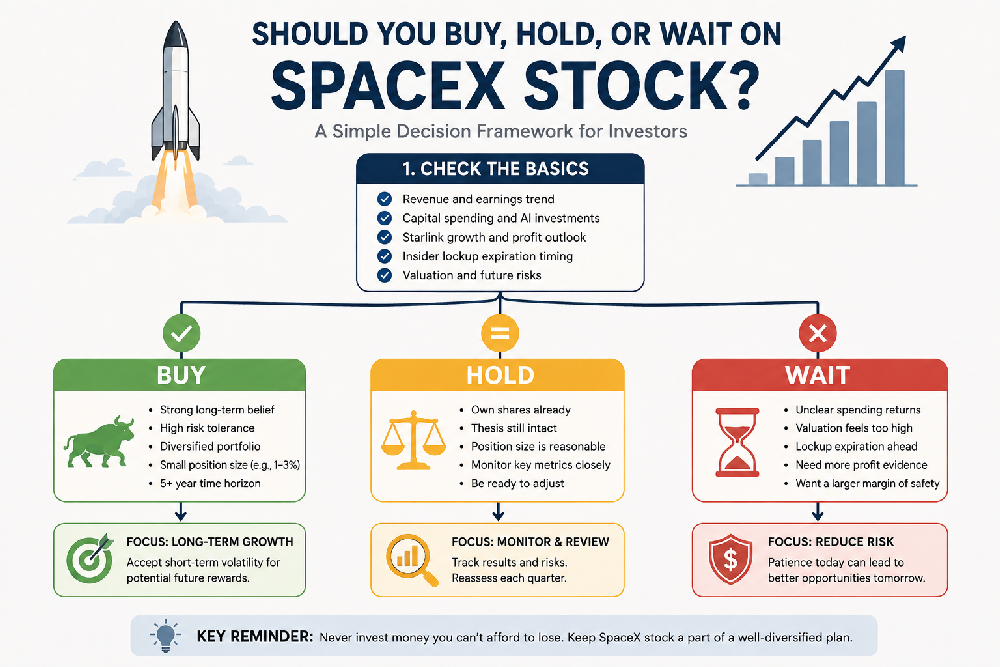
A Simple Buy, Hold, or Wait Framework
| Choice | May fit you when | Main risk |
|---|---|---|
| Buy | You have a long horizon, strong risk tolerance, and a diversified portfolio | High valuation and continued heavy spending |
| Hold | You already own shares and the original long-term thesis remains valid | The position may become too large or the thesis may weaken |
| Wait | You want more evidence of profitability, cash flow, and spending discipline | The stock could rise before uncertainty clears |
Frequently Asked Questions
What is the SpaceX stock ticker?
SpaceX trades under the ticker symbol SPCX. Investors should confirm the symbol with their brokerage before placing an order and avoid similarly named securities.
Why did SpaceX stock drop after an earnings beat?
The company reported stronger-than-expected revenue, but investors focused on high capital spending, continued losses, AI investment costs, and the upcoming release of insider shares. Stock prices reflect future expectations, not just the latest sales number.
Is SpaceX profitable?
The company reported a net loss for the quarter covered by its first public earnings report. Some business segments may produce positive earnings or adjusted cash flow, but investors should review consolidated net income and free cash flow rather than relying on one favorable metric.
Could the lockup expiration cause a crash?
It could increase volatility, but a decline is not guaranteed. Eligible insiders may choose not to sell. The main issue is that a much larger supply of shares can enter the market, which may pressure the price if demand does not rise at the same pace.
Should beginners buy SpaceX stock?
Beginners should first build an emergency fund, reduce high-interest debt, and establish a diversified core portfolio. SpaceX may be more appropriate as a small speculative position than as a primary retirement holding.
The Bottom Line
SpaceX’s first earnings report showed that the company is growing quickly. Revenue rose sharply, and demand across satellite internet, government services, launches, and emerging technology appears substantial.
However, rapid growth comes with major costs. Heavy AI and infrastructure spending, continued net losses, a demanding valuation, and an upcoming insider-share release could keep SpaceX stock volatile.
Buying may suit investors with long time horizons and room for a small speculative position. Holding may make sense for shareholders whose original thesis remains intact. Waiting may be best for investors who want clearer evidence of sustainable profits and cash flow.
The safest approach is to connect the decision to your own finances. Do not invest emergency savings, money needed soon, or funds required to pay down expensive debt. SpaceX may have enormous potential, but no single company should determine whether you reach your retirement or savings goals.
References
- SpaceX Investor Relations — Official source for earnings materials, presentations, financial reports, and company filings.
- U.S. Securities and Exchange Commission: SpaceX Registration Filing — Supports information about the company’s business structure, finances, debt, risks, and public offering.
- SEC SpaceX IPO Prospectus Amendment — Supports details about the initial public offering, share structure, and offering terms.
- The Wall Street Journal: SpaceX Earnings Coverage — Supports the reported second-quarter revenue growth and market reaction.
- MarketWatch: SpaceX First Earnings Report — Supports information about the earnings release, investor expectations, and post-report stock movement.
- Investor.gov: Diversification — Explains why spreading investments across multiple assets can reduce the effect of one stock’s losses.