
PLTR stock jumped in after-hours trading after Palantir Technologies reported a much stronger second quarter than Wall Street expected. The company posted rapid growth in both its commercial and government businesses, raised its full-year outlook, and showed that demand for its artificial intelligence software remains strong.
Those results are impressive. They do not automatically make the stock a good buy at any price.
For individual investors, the important question is not whether Palantir had a good quarter. It clearly did. The better question is whether the company’s future growth can justify the price investors are being asked to pay today. That requires looking at revenue growth, profits, valuation, volatility, and how PLTR stock would fit into a broader financial plan.
What Changed in Palantir’s Latest Earnings Report?
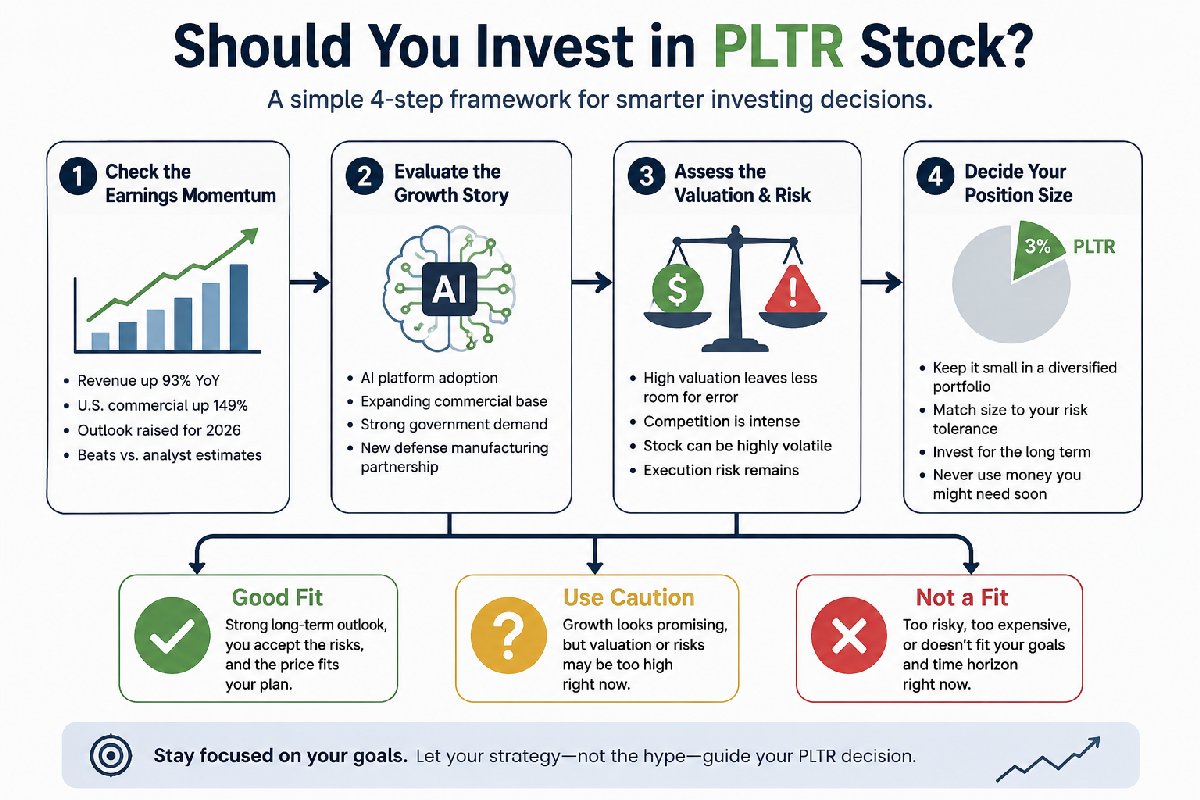
Palantir reported second-quarter 2026 revenue of about $1.94 billion, up 93% from the same period a year earlier. Analysts had expected roughly $1.81 billion. Adjusted earnings were 41 cents per share, compared with an expected 34 cents per share.
The largest surprise came from the company’s U.S. operations. U.S. commercial revenue, which includes sales to private businesses rather than government agencies, increased 149% year over year to approximately $764 million. U.S. government revenue rose 90% to about $809 million.
Palantir also raised its expected 2026 revenue to a range of approximately $8.15 billion to $8.16 billion. Its previous forecast had been below $7.7 billion. The stock rose roughly 12% in after-hours trading following the announcement, although the final market reaction can change when regular trading resumes.
| Q2 2026 measure | Reported result | Why investors care |
|---|---|---|
| Total revenue | About $1.94 billion | Shows demand remained stronger than analysts expected |
| Year-over-year revenue growth | 93% | Supports the argument that Palantir remains a high-growth company |
| Adjusted earnings per share | $0.41 | Suggests growth is producing meaningful profit, not only higher sales |
| U.S. commercial growth | 149% | Indicates Palantir is expanding beyond its government roots |
| U.S. government growth | 90% | Shows continued strength in defense and public-sector contracts |
| Updated 2026 revenue outlook | About $8.15 billion to $8.16 billion | Raises expectations for the rest of the year |
Why the U.S. Commercial Business Matters
Palantir was once viewed mainly as a government contractor. Its software helps organizations combine large amounts of data, find useful patterns, and make operational decisions. Government agencies use these tools for defense, logistics, intelligence, and other complex projects.
The rapid expansion of the U.S. commercial segment changes the investment story. Businesses are using Palantir’s software to manage factories, supply chains, healthcare operations, financial data, and artificial intelligence projects.
Commercial growth can give the company a larger market than government contracts alone. It may also reduce dependence on a small number of public-sector customers. However, investors should confirm that this growth continues for several quarters. One exceptional quarter does not guarantee the same rate will continue.
Growth percentages can also become harder to maintain as the revenue base becomes larger. A 149% increase from today’s higher starting point would require far more new business next year than it did this year.
How Palantir’s AI Story Supports PLTR Stock
Palantir’s Artificial Intelligence Platform, often called AIP, helps organizations connect AI models with their own data and daily operations. Instead of using an AI chatbot only to answer questions, a company might use Palantir to plan inventory, identify production problems, schedule workers, or manage equipment.
This practical use is a major part of the bullish case for PLTR stock. Businesses may be more willing to pay for AI software when they can connect it to measurable savings, faster production, or better decisions.
Palantir also benefits from increased demand for secure AI systems. Large companies and government agencies often cannot place sensitive information into open consumer tools. Palantir markets its platforms as a way to use AI while maintaining control over access, security, and internal data.
Still, the AI market is highly competitive. Cloud providers, software companies, consulting firms, and AI model developers all want a larger share of corporate technology budgets. Palantir must continue proving that its platform is valuable enough to justify its price and implementation demands.
What the Mercury Systems Partnership Could Mean
On the same day as the earnings release, Mercury Systems announced a strategic agreement with Palantir. The companies plan to use Palantir software to automate material planning and factory operations for technologies supplied to U.S. military programs.
This partnership is relevant because it provides another example of Palantir moving from data analysis into real-world industrial operations. Faster material planning and factory production could help defense suppliers deliver equipment more efficiently.
However, investors should avoid treating every partnership announcement as guaranteed revenue. The key details are contract size, duration, rollout timing, and whether the project expands after the initial deployment. Those financial terms were not fully described in the public announcement.
The Main Concern: PLTR Stock’s Valuation
A great company can still be a risky investment when its stock price assumes years of near-perfect performance.
Before the latest earnings report, PLTR stock was already trading at a high multiple of expected earnings and sales compared with many established software companies. Exact valuation measures move with the share price and with analysts’ updated forecasts, so investors should check current figures rather than rely on an old screenshot or social media post.
A high valuation means the market expects strong growth to continue. When a company exceeds expectations, the stock can rise quickly. When growth slows even slightly, the price can fall sharply because investors may no longer be willing to pay the same premium.
Consider a simplified example. Suppose one stock trades at 15 times annual sales and another trades at 40 times annual sales. The second company may deserve a higher valuation because it is growing faster. But it also has less room for disappointment. A missed contract, slower commercial growth, lower profit margins, or weaker guidance could cause a larger decline.
A Practical Position-Size Example
Investors do not have to choose between buying a large amount of PLTR stock and avoiding it completely. Position size can control risk.
Assume an investor has a $50,000 portfolio and is considering a 3% allocation to PLTR stock.
Position amount = portfolio value × target allocation
$50,000 × 0.03 = $1,500
If PLTR stock later fell 40%, that position would lose approximately $600.
$1,500 × 0.40 = $600
The total portfolio would decline by about 1.2% from that investment, assuming the other holdings did not change.
This example shows why position sizing matters. A volatile growth stock can be manageable as a small part of a diversified portfolio. It can become financially damaging when it represents money needed for rent, debt payments, tuition, an emergency fund, or near-term retirement expenses.
Should You Buy PLTR Stock After the Earnings Jump?
The answer depends on your time horizon, risk tolerance, and current finances. Buying immediately after a sharp rally can expose investors to short-term price swings. Strong results may attract long-term buyers, but they can also attract traders who sell quickly after the initial excitement.
| Your situation | Possible approach |
|---|---|
| You have high-interest credit card debt | Paying down the debt may offer a more predictable financial benefit than buying a volatile stock |
| You do not have an emergency fund | Build cash savings before placing essential money into PLTR stock |
| You are investing for retirement in 20 years | A small position may fit if the rest of the portfolio is diversified |
| You already own several AI stocks | Review whether buying PLTR would create too much exposure to one investment theme |
| You are worried about buying after the rally | Consider purchasing in smaller stages instead of investing the full amount at once |
| You need the money within three years | A volatile individual stock may not match that short time horizon |
Investing gradually, sometimes called dollar-cost averaging, can reduce the risk of putting all your money into the stock on a particularly expensive day. It does not prevent losses, but it spreads the entry price across multiple purchases.
Key Risks Investors Should Watch
Valuation risk: PLTR stock may fall even if Palantir remains profitable, especially if future growth does not meet the market’s high expectations.
Customer concentration: Large government and enterprise contracts can produce strong revenue, but delays or cancellations may affect quarterly results.
International weakness: Palantir’s U.S. business is growing rapidly, while its international expansion has been less consistent. Weakness outside the United States could limit long-term growth.
Competition: Major cloud, software, defense, and AI companies are building competing data and automation tools.
Stock volatility: Earnings announcements, contract news, analyst ratings, and changes in interest-rate expectations can cause large short-term moves.
Execution risk: Palantir must turn strong demand into lasting contracts, recurring revenue, and continued profit growth.
What to Monitor in Future Palantir Earnings
Investors should watch more than the headline earnings number. Important measures include U.S. commercial growth, remaining contract value, customer growth, operating margin, free cash flow, stock-based compensation, and updated annual guidance.
It is also useful to compare reported results with expectations. A company can post rapid growth and still see its stock decline if investors expected even more. The market often reacts to the gap between actual performance and anticipated performance.
Frequently Asked Questions
Why did PLTR stock rise after earnings?
The stock rose because Palantir reported revenue and adjusted earnings above analysts’ estimates, delivered very strong U.S. commercial and government growth, and raised its full-year revenue forecast.
Is Palantir profitable?
Palantir reported positive net income and strong adjusted operating results in the second quarter. Investors should still review both generally accepted accounting principles results and adjusted figures, because adjusted earnings may exclude certain expenses.
Is PLTR stock suitable for beginners?
It can be difficult for beginners because the shares may be volatile and the valuation depends heavily on future growth. A diversified index fund is generally easier to understand and less dependent on one company. Beginners who buy PLTR may prefer to keep it as a small portfolio position.
Should I buy PLTR stock all at once?
There is no single correct method. Investing in smaller stages can lower the risk of choosing one poor entry point. However, the stock can still decline after every purchase, so gradual buying should not replace research or diversification.
Can PLTR stock keep rising?
It can rise if Palantir continues delivering rapid growth, expanding profits, and stronger commercial adoption. It can also fall if growth slows, competition increases, or investors decide the valuation is too high. Strong business results do not remove stock-price risk.
Bottom Line
Palantir’s second-quarter results strengthened the company’s AI growth story. Revenue nearly doubled, U.S. commercial sales surged, government demand remained strong, and management raised its outlook. These are meaningful positives for long-term investors.
The challenge is price. PLTR stock carries high expectations, so future results may need to remain exceptional to support its valuation. Investors should avoid buying only because the stock is rising or because AI remains popular.
A more practical approach is to examine your emergency savings, debt, retirement plan, existing technology exposure, and ability to handle a large decline. Palantir may deserve a place in a growth-oriented portfolio, but the size of that place matters as much as the decision to buy.
References
- Palantir Investor Relations: Quarterly Results — Supports the company’s reported revenue, earnings, guidance, and operating performance.
- U.S. Securities and Exchange Commission: Palantir Filings — Provides official financial statements, risk disclosures, and regulatory filings.
- Reuters: Palantir Raises Annual Revenue Forecast — Supports the earnings comparison, revised outlook, and after-hours market reaction.
- Mercury Systems and Palantir Partnership Announcement — Supports details about the defense manufacturing and factory automation agreement.
- Investor.gov: Stocks — Supports general explanations of stock ownership, volatility, diversification, and investment risk.