
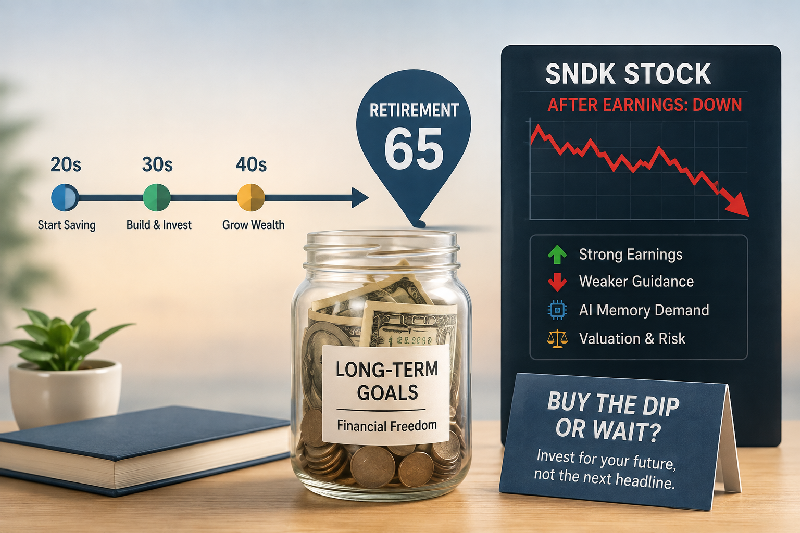
SNDK stock fell after Sandisk released strong quarterly results but gave a revenue forecast that did not fully satisfy investors. That may sound confusing. A company can report fast growth, rising profits, and improving demand, yet still see its stock price drop.
The reason is simple: stock prices reflect expectations about the future, not only results from the past. When a stock has already climbed sharply, investors may expect nearly perfect numbers. Even good guidance can disappoint when Wall Street was hoping for more.
For individual investors, the key question is not whether Sandisk had a good quarter. The more useful question is whether SNDK stock offers a reasonable balance of potential return and risk at its current valuation. That decision depends on your time horizon, portfolio size, financial priorities, and ability to handle large price swings.
What Happened in Sandisk’s Latest Earnings Report?
Sandisk reported fiscal fourth-quarter 2026 revenue of approximately $8.97 billion. Revenue increased 51% from the previous quarter. The company reported GAAP diluted earnings of $43.97 per share and adjusted diluted earnings of $39.25 per share.
Growth was especially strong in Sandisk’s data-center business. Quarterly data-center revenue reached about $2.98 billion, more than double the prior quarter. Edge-market revenue, which includes storage used in computing and connected devices, rose to about $5.43 billion. Consumer revenue declined to $556 million.
Management said the quarterly revenue increase came from both higher sales volumes and stronger pricing. About one-third of the sequential growth came from volume, while roughly two-thirds came from pricing.
For the next quarter, Sandisk projected revenue between $10.3 billion and $10.8 billion. It also forecast adjusted earnings of $44 to $46 per share. Those numbers still indicate substantial profitability, but the midpoint of the revenue range was slightly below some market expectations.
| Metric | Fiscal Q4 2026 | What It Means |
|---|---|---|
| Revenue | About $8.97 billion | Strong sales growth supported by pricing and demand |
| Sequential revenue growth | 51% | Business momentum accelerated from the previous quarter |
| Adjusted earnings per share | $39.25 | Profitability was stronger than many investors expected |
| Next-quarter revenue guidance | $10.3 billion to $10.8 billion | Continued growth, but not enough to exceed high expectations |
| Next-quarter adjusted EPS guidance | $44 to $46 | Management expects profits to remain strong |
Why Did SNDK Stock Fall Despite Strong Earnings?
A stock often falls after good earnings when investors had already priced in even better results. SNDK stock had experienced a major rally before the report. That raised the standard the company needed to clear.
Imagine that investors expected a student to score 100 on a test. A score of 95 is excellent, but it is still below the expectation. The same idea applies to stocks. Sandisk’s business results were strong, but the revenue forecast did not exceed the market’s high hopes.
Several other factors may also have contributed to the reaction:
- Profit-taking: Investors who bought earlier may have used the earnings report as an opportunity to lock in gains.
- High valuation: When a stock trades at an expensive price compared with its earnings, even a small disappointment can cause a large decline.
- Memory-market uncertainty: NAND flash prices can rise and fall sharply as supply and demand change.
- AI expectations: Investors may be treating every memory company as an AI winner, creating expectations that are difficult to meet every quarter.
How Much Does AI Matter to Sandisk?
Artificial intelligence systems require enormous amounts of data storage. Training and operating AI models creates demand for data-center infrastructure, including flash memory and solid-state drives.
Sandisk’s data-center revenue growth suggests that the company is benefiting from this trend. The company also sells products used in edge devices, consumer electronics, enterprise systems, and cloud environments.
However, investors should avoid assuming that all AI-related demand will translate into permanent profit growth. Memory is a cyclical industry. When demand is high and supply is limited, prices and margins can rise quickly. When manufacturers add capacity or customers reduce orders, prices may fall just as fast.
This means SNDK stock may behave differently from a software company with recurring subscription revenue. Sandisk can benefit strongly during an upcycle, but earnings may also be more sensitive to pricing, inventory levels, manufacturing decisions, and customer spending.
The Most Important Risk: Buying After a Huge Rally
A falling stock is not automatically cheap. A stock can drop 5% or 10% and still trade at an expensive valuation if it previously rose several hundred percent.
Before buying SNDK stock, compare the current share price with the company’s expected earnings. One simple measure is the forward price-to-earnings ratio, commonly called the forward P/E ratio.
Forward P/E = Current share price ÷ Expected earnings per share
For example, suppose SNDK traded at $1,300 and analysts expected the company to earn $100 per share over the next year. The forward P/E would be:
$1,300 ÷ $100 = 13
A P/E of 13 may look reasonable, but only if the earnings estimate is dependable. If memory prices weaken and expected earnings fall to $60 per share, the effective P/E becomes about 22. That is why investors should not rely on a single earnings forecast when valuing a cyclical company.
It may be more useful to review several scenarios.
| Scenario | Possible Business Trend | Potential Effect on SNDK Stock |
|---|---|---|
| Bull case | AI storage demand stays strong and NAND prices remain elevated | Revenue and earnings could continue to exceed expectations |
| Base case | Demand grows, but pricing gains slow | Stock returns may depend more heavily on valuation |
| Bear case | Supply increases or customers reduce orders | Margins and earnings could fall quickly |
Should You Buy the Dip in SNDK Stock?
Buying the dip may make sense for an investor who understands the memory industry, has a long time horizon, and can tolerate substantial volatility. It is less suitable for someone who needs the money soon or who would panic during a 30% decline.
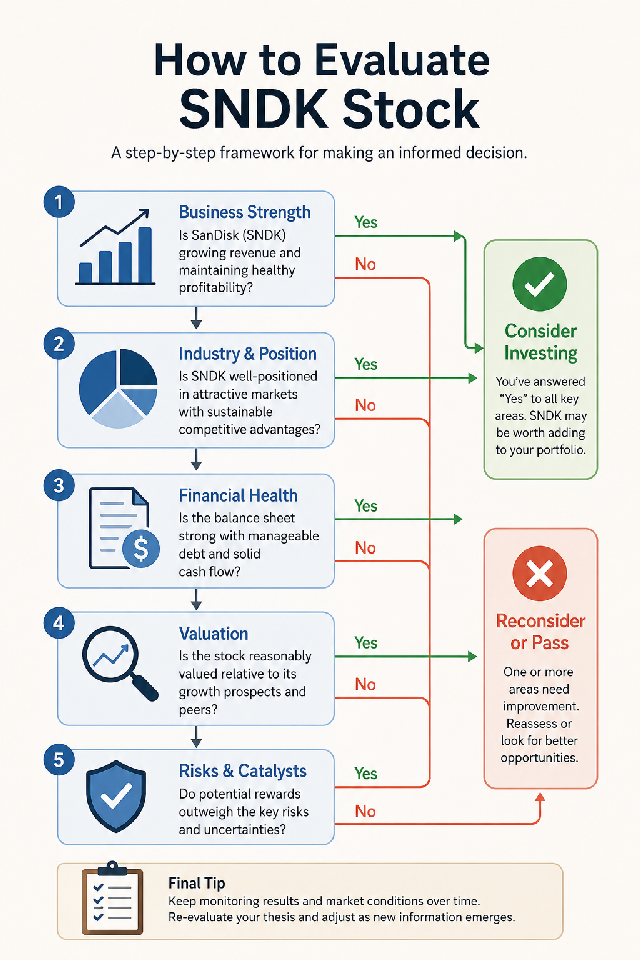
SNDK may be worth considering when all of the following are true:
- You already have an emergency fund.
- You are not carrying high-interest credit-card debt.
- You are investing for at least five years.
- Your portfolio is diversified across many companies and sectors.
- You can accept the possibility that memory prices and earnings may fall.
- Your position would remain small enough that a major loss would not damage your financial plans.
The stock may be less appropriate when you are saving for a home down payment, tuition, a tax bill, or another near-term expense. Money needed within a few years generally should not depend on the performance of one volatile technology stock.
A Practical Position-Sizing Example
Suppose an investor has a $50,000 portfolio and wants exposure to SNDK without making it the center of the portfolio.
A 2% position would equal:
$50,000 × 0.02 = $1,000
If SNDK later fell 40%, the position would lose $400. That would reduce the full portfolio by about 0.8%, assuming other holdings did not change.
By contrast, a 15% position would equal $7,500. A 40% decline would cause a $3,000 loss, cutting the portfolio by 6%. The same stock decline creates a much larger financial and emotional impact when the position is oversized.
This example shows why position size may matter more than finding the perfect entry price.
Buy Now, Buy Slowly, or Wait?
| Approach | When It May Fit | Main Tradeoff |
|---|---|---|
| Buy now | You believe the valuation is reasonable and can tolerate volatility | The stock could fall further after the first post-earnings decline |
| Buy in stages | You want exposure but are uncertain about the near-term price | You may pay more later if the stock rebounds quickly |
| Wait | You want more evidence about guidance, demand, or valuation | You could miss gains if business momentum stays strong |
Buying in stages can reduce the pressure to choose one exact entry point. An investor planning to invest $1,200 could buy $400 now, $400 after the next business update, and $400 after the next earnings report. This does not prevent losses, but it reduces the risk of investing the full amount immediately before another decline.
What Investors Should Watch Next
The next earnings report will matter, but investors should monitor more than revenue and earnings per share.
- NAND pricing: Continued price increases could support margins, while falling prices could reduce profits.
- Data-center revenue: Investors need to see whether AI-related storage demand remains durable.
- Customer agreements: Long-term supply deals may improve revenue visibility, but investors should examine pricing and obligations.
- Consumer weakness: Consumer revenue declined in the latest quarter, so future reports should show whether that segment stabilizes.
- Gross margin: Sandisk reported an unusually high quarterly gross margin. Investors should evaluate whether that level is sustainable.
- Share repurchases: The board expanded its buyback authorization. Buybacks can support earnings per share, but only create value when shares are repurchased at sensible prices.
- Analyst estimates: Watch whether analysts raise or lower future earnings forecasts after reviewing management’s outlook.
Frequently Asked Questions
Why is SNDK stock dropping after earnings?
SNDK stock declined because the company’s next-quarter revenue forecast did not exceed the market’s high expectations. Investors may also have taken profits following the stock’s earlier rally.
Is Sandisk benefiting from artificial intelligence?
Yes. AI systems require large amounts of high-speed storage, and Sandisk’s data-center business has grown rapidly. However, AI demand does not remove the normal pricing and supply risks of the memory industry.
Is SNDK stock cheap after the drop?
Not necessarily. A stock is not cheap simply because its price declined. Investors should compare the share price with normalized earnings, cash flow, growth expectations, and the company’s historical industry cycle.
Should retirement investors buy SNDK stock?
A small position may fit a diversified retirement portfolio for investors who can handle volatility. It should not replace broad index funds, bonds, cash reserves, or other core retirement holdings.
What is the safest way to invest in SNDK?
No stock purchase is completely safe. Risk can be reduced by keeping the position small, investing gradually, maintaining diversification, and avoiding the use of borrowed money or funds needed for near-term expenses.
Bottom Line
Sandisk delivered strong earnings, rapid revenue growth, expanding data-center sales, and a profitable outlook. The market’s negative response was mainly about expectations. Investors had already priced in extraordinary growth, so guidance that was merely strong was not enough.
SNDK stock may still have long-term potential if AI storage demand remains strong and NAND pricing stays favorable. The main risk is that current profits may reflect an unusually strong part of the memory cycle. If prices, demand, or margins normalize, earnings could fall even while the company remains healthy.
For most individual investors, the choice does not have to be a full commitment or complete avoidance. A small position purchased gradually may offer exposure while limiting damage if the stock remains volatile. Investors who are uncomfortable with the valuation or industry cycle can wait for additional earnings reports without treating every price decline as a missed opportunity.
References
- Sandisk Fiscal Fourth Quarter 2026 Financial Results — Supports the reported revenue, earnings, segment performance, guidance, margins, and share-repurchase figures.
- Sandisk Investor Relations — Provides official earnings presentations, company events, financial reports, and investor updates.
- Sandisk SEC Filings — Provides access to regulatory filings covering financial statements, business risks, and corporate disclosures.
- U.S. Securities and Exchange Commission: Diversification — Explains how spreading investments can reduce the impact of losses in a single holding.
- FINRA: Understanding Investment Risk — Supports the discussion of volatility, time horizon, risk tolerance, and investment suitability.