
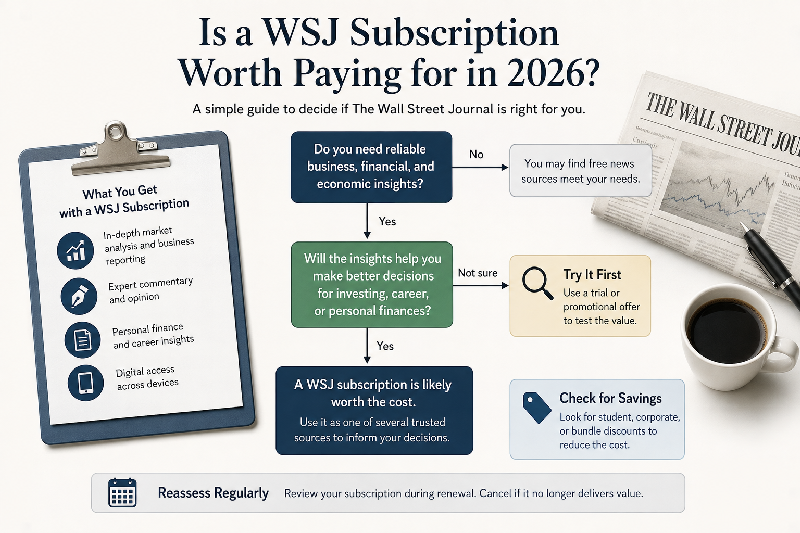
The Wall Street Journal is one of the best-known sources for business, markets, economics, technology, and corporate news. But recognition alone does not make a subscription worth paying for.
The practical question is simple: Will reading the Journal help you make better decisions about your money, investments, career, or business? Or will it become another recurring charge that you rarely use?
Interest in The Wall Street Journal has recently increased as its coverage of stock valuations, artificial intelligence, cryptocurrency rules, workplace trends, and consumer behavior circulates online. These stories can be useful, but subscribing should not depend on one interesting headline. The value comes from whether you use the publication consistently and understand how to separate reporting, analysis, and opinion.
What Do You Get With a Wall Street Journal Subscription?
A standard digital subscription generally provides access to articles on WSJ.com and through the WSJ mobile app. Depending on the offer, a digital package may also include access to related Dow Jones publications or services, such as MarketWatch or Barron’s.
A print subscription usually includes home delivery plus digital access. Delivery frequency and availability may depend on your location and the specific plan offered when you subscribe.
The Journal covers several areas that may affect personal financial decisions:
- Markets and investing: Stocks, bonds, interest rates, commodities, and economic developments.
- Companies: Earnings, mergers, management changes, business strategy, and industry competition.
- Personal finance: Retirement, taxes, insurance, housing, credit, banking, and consumer spending.
- Careers and workplaces: Hiring trends, salaries, remote work, artificial intelligence, and job-market changes.
- Government policy: Regulations and legislation that may affect businesses, investors, workers, or consumers.
- Opinion: Editorials and commentary that argue for particular positions.
Much of this content sits behind a paywall. Non-subscribers may see headlines, article previews, or a limited number of accessible stories, but regular reading usually requires a paid plan.
How Much Does The Wall Street Journal Cost?
Subscription pricing changes frequently. Introductory offers can be much cheaper than the regular renewal rate, and different visitors may see different promotions.
For example, the official WSJ subscription store has advertised limited-time digital promotions priced by the week and billed every four weeks. Student subscriptions may be available for around $4 per month, subject to eligibility verification. These offers can change, so the price shown at checkout is more important than any price mentioned in an article or advertisement.
| Plan type | What it may include | Best suited for | Cost issue to check |
|---|---|---|---|
| Digital | Website and app access, newsletters, podcasts, and possible bundled publications | Regular readers who do not need paper delivery | Introductory price versus renewal price |
| Print plus digital | Home delivery and online access | Readers who prefer a physical newspaper | Delivery schedule, local availability, and full renewal rate |
| Student | Discounted digital access and student-focused features | Eligible college or university students | Verification rules and post-student pricing |
| Employer or school access | Access paid for by an organization or institution | Employees, faculty members, and students | Whether access ends when employment or enrollment changes |
Before subscribing, take a screenshot or save a copy of the checkout page. Record the promotional price, billing frequency, renewal date, and future rate. A price such as “$3 per week” may be billed as a larger amount every four weeks rather than charged weekly.
The Most Important Calculation: Cost Per Useful Read
You do not need a complex formula to judge a news subscription. Divide your monthly cost by the number of articles you genuinely use.
Cost per useful article = monthly subscription cost ÷ useful articles read per month
Suppose your plan costs $12 every four weeks and you read 16 useful articles during that billing period:
$12 ÷ 16 = $0.75 per useful article
That may be reasonable if the articles improve your investing research, help you prepare for a job interview, or prevent a poor financial decision.
Now suppose the introductory period ends and the subscription renews at $55 every four weeks. If you still read only four useful articles, the calculation changes:
$55 ÷ 4 = $13.75 per useful article
At that point, free sources or a cheaper publication may serve you better.
When a WSJ Subscription May Be Worth It
You regularly research investments
The Journal can help investors understand what is moving a company or industry. Coverage of earnings, management decisions, regulation, competition, and economic conditions can add context that a stock-price chart cannot provide.
Recent attention around topics such as AstraZeneca’s valuation and cryptocurrency legislation shows how the Journal can present arguments that investors may want to examine. However, an article calling a stock attractive is not a substitute for reviewing the company’s financial statements, valuation, debt, risks, and fit within your portfolio.
The subscription offers more value when you use it as one research input rather than as a stream of buy-or-sell signals.
Your career depends on business developments
Professionals in finance, consulting, technology, healthcare, law, government, marketing, or management may benefit from understanding what is happening across major industries.
For example, reporting about LinkedIn encouraging users to rely less heavily on artificial intelligence could matter to job seekers, recruiters, and professionals building an online presence. The practical lesson is not simply that a platform changed direction. It is that employers may place greater value on original thinking, specific experience, and authentic communication.
A subscription may be worthwhile when the information helps you prepare for meetings, interviews, client conversations, or strategic decisions.
You own a business or manage a team
Business owners may use the Journal to follow interest rates, labor costs, consumer demand, technology changes, and regulation. A single useful insight about hiring, pricing, or industry risk could be worth more than several months of subscription fees.
Before paying personally, check whether your employer already provides access. Dow Jones offers corporate subscriptions for organizations and teams, and some companies include news access as an employee benefit.
You have a consistent reading routine
A subscription is more likely to deliver value when you already know when and how you will use it. You might read a morning newsletter, save two articles for lunch, or review one industry section each weekend.
Without a routine, even strong journalism can turn into an unused monthly bill.
When It May Not Be Worth the Cost
You mainly need stock prices and basic market headlines
Real-time or delayed quotes, company press releases, regulatory filings, and basic financial news are available from many free sources. Paying for the Journal may be unnecessary if you only check whether the market rose or fell.
You rarely read long-form reporting
Some readers subscribe after encountering one popular article and then stop visiting the site. A promotional price can make this behavior seem harmless, but the cost becomes more noticeable after renewal.
Review your browser history or app usage after the first month. If you are not opening the Journal at least once or twice per week, cancellation may be the better financial decision.
You are carrying expensive debt
A news subscription is a discretionary expense. It should not take priority over minimum debt payments, essential bills, or a starter emergency fund.
Someone paying 25% interest on a credit-card balance may gain more by putting an extra $30 or $50 toward debt each month than by adding another paid publication. Free library access or public financial resources can fill the information gap while the debt is being reduced.
You react emotionally to financial headlines
Frequent market coverage can encourage unnecessary trading. Headlines often focus on what changed today, while retirement investing usually depends on decisions made over many years.
If news makes you buy after prices rise or sell during every decline, more information may not improve your results. A simple diversified investment plan and a less frequent review schedule may be healthier.
Reporting, Analysis, and Opinion Are Not the Same
This distinction is essential for getting value from The Wall Street Journal.
News reporting aims to explain events using facts, sources, documents, and interviews. Analysis interprets what those events may mean. Opinion argues for a viewpoint.
An opinion article about cryptocurrency regulation, taxes, corporate policy, or consumer trends should not be treated as neutral reporting. It may still be useful because it explains an argument you can evaluate. But readers should identify the section, examine the evidence, and compare the position with other credible sources.
When reading any investment-related story, ask:
- Is this reporting, analysis, or opinion?
- What evidence supports the main claim?
- What risks or opposing views are missing?
- Does this information change my long-term plan?
- Am I tempted to act because of evidence or emotion?
Check for Free or Discounted Access First
Do not pay full price until you have checked other access options.
- College or university access: Some schools provide WSJ access to students and faculty at no direct cost.
- Student plans: Eligible students may qualify for a deeply discounted subscription.
- Employer access: Large employers and professional teams may offer corporate subscriptions.
- Public libraries: Some libraries provide newspaper databases or digital publication access. Availability varies.
- Promotional bundles: A WSJ offer may include other Dow Jones products, but a bundle is valuable only if you use them.
Students can search the Journal’s education site to see whether their institution sponsors access. This should be the first step before purchasing a personal plan.
Understand Renewal and Cancellation Terms
The low introductory price is not necessarily the long-term cost. Read the billing details before entering payment information.
Confirm these five points:
- The exact amount charged today.
- How often the payment is collected.
- The date the promotional period ends.
- The regular renewal price.
- The method required to cancel.
WSJ directs subscribers to its Customer Center or customer service for subscription changes and cancellations. The available method may depend on where and how you subscribed. A subscription purchased through an app store may need to be canceled through that store rather than directly through WSJ.
Set a calendar reminder at least seven days before the promotional period ends. Do not rely on remembering months later.
How WSJ Compares With Lower-Cost Alternatives
No single publication is best for every reader. The right choice depends on the decisions you are trying to make.
| Need | Possible source | What it does well |
|---|---|---|
| Company disclosures | SEC EDGAR and investor-relations pages | Provides original filings and earnings materials for free |
| Economic data | Federal Reserve, Bureau of Labor Statistics, and government agencies | Offers primary data without a subscription |
| Basic market coverage | MarketWatch, CNBC, Yahoo Finance, or brokerage research | Provides headlines, quotes, and general market updates |
| Deep business reporting | WSJ, Financial Times, Bloomberg, or similar paid publications | Adds reporting, context, interviews, and industry analysis |
| Personal finance guidance | Consumer Financial Protection Bureau, IRS, state agencies, and nonprofit resources | Provides official rules and practical consumer information |
The Journal is strongest as a broad business-news product. It is less essential when you need only official tax instructions, a credit report, a mortgage calculator, or basic stock data.
A Simple 30-Day Test
Use the first month as a trial, even when the subscription is not officially labeled that way.
- Choose three topics you want to follow, such as retirement, your industry, and the economy.
- Read or save at least three articles per week.
- Record any action or useful insight that came from the coverage.
- Review how much time you spent using the subscription.
- Compare the renewal price with your actual use.
Keep the subscription only when it produces clear value. That value might be financial, professional, educational, or simply the enjoyment of staying informed. It does not have to generate a direct profit, but it should justify its place in your budget.
Frequently Asked Questions
Is The Wall Street Journal worth it for beginners?
It can be, especially for readers who want to learn how companies, markets, and the economy connect. Beginners should avoid treating individual columns or stock stories as personalized investment advice. Start with general business reporting and personal finance coverage before acting on more complex analysis.
Can I read WSJ articles for free?
Some content may be accessible without a subscription, but much of the site is behind a paywall. Schools, employers, and libraries may provide free institutional access.
Does a WSJ subscription include Barron’s and MarketWatch?
Some promotional digital packages include access to additional Dow Jones publications, while other plans may not. Check the exact benefits shown during checkout rather than assuming every subscription includes the same bundle.
Is the print edition better than digital?
The print edition may be better for readers who enjoy a structured daily reading experience and want fewer digital distractions. Digital access is usually more convenient, searchable, and easier to use throughout the day.
Should I subscribe for stock recommendations?
No subscription should be purchased mainly to receive stock picks. Use journalism to identify questions, risks, and trends. Then review company filings, valuation, diversification, and your own time horizon before investing.
Final Verdict: Is The Wall Street Journal Worth Paying For?
A Wall Street Journal subscription can be worth the money for regular investors, professionals, business owners, students, and readers who actively follow economic or corporate developments. Its value comes from consistent use, not from one viral headline.
It is less attractive for people who only want free market quotes, rarely read business news, carry high-interest debt, or tend to make impulsive trades after seeing dramatic headlines.
Start by checking for free access through your school, employer, or library. If you subscribe directly, compare the introductory rate with the renewal price and set a reminder before the promotion ends. After 30 days, calculate your cost per useful read and decide whether the publication is helping you make better choices.
The best subscription is not the one with the strongest reputation. It is the one you actually use.
References
- The Wall Street Journal Subscription Store — Supports current plan descriptions, promotional pricing, billing information, and digital bundle details.
- WSJ Cancellation and Refund Policy — Supports information about managing, changing, or canceling a subscription.
- WSJ for Students — Supports student subscription benefits and discounted access options.
- WSJ School-Sponsored Access Search — Supports the recommendation that students check whether their college or university provides access.
- Dow Jones WSJ Corporate Subscriptions — Supports information about employer and team subscription programs.
- SEC EDGAR Company Filings — Supports the use of free primary company filings as a supplement to financial journalism.