

If you receive Social Security, one number may have a surprisingly large effect on your 2027 household budget: the cost-of-living adjustment, or COLA.
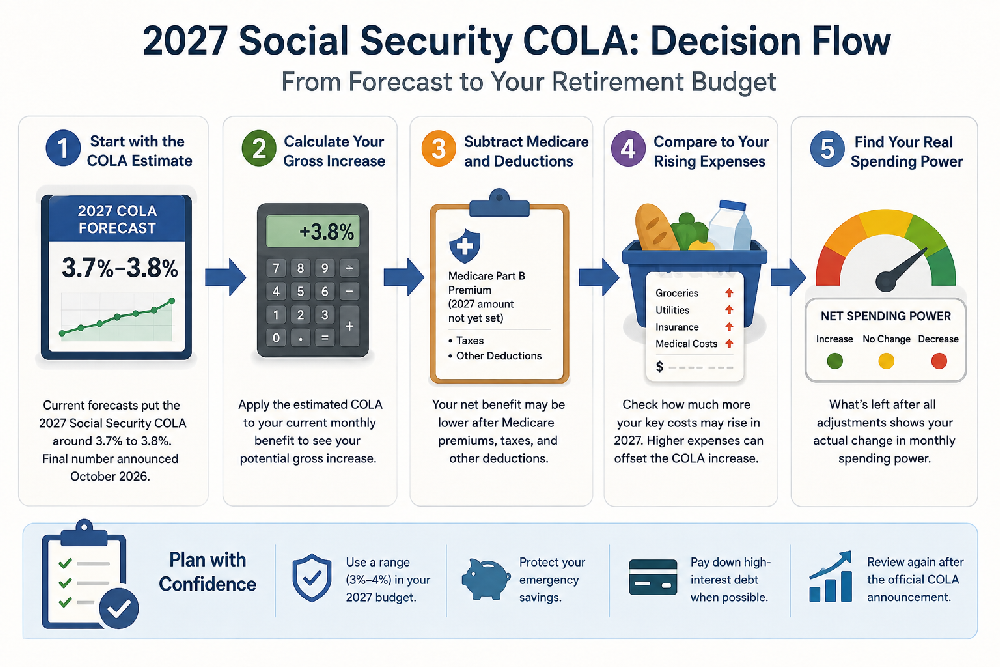
Early estimates for the 2027 Social Security COLA are currently landing around 3.7% to 3.8% in several forecasts. That would be noticeably larger than the 2.8% increase applied for 2026. But the 2027 number is not official yet, and retirees should be careful about treating any forecast as guaranteed income.
The final adjustment will depend on inflation data released later in 2026. That means the most useful question right now is not simply, “How big will the COLA be?” It is: How should you plan your retirement budget while the number is still uncertain?
What Is the Latest 2027 Social Security COLA Estimate?
As of early August 2026, several forecasts have put the possible 2027 Social Security COLA near 3.7% to 3.8%. Some estimates have moved higher or lower during the year as inflation, energy prices, and other costs changed.
That range should be viewed as a forecast, not an announced benefit increase. The Social Security Administration says the next COLA will be announced in October 2026.
There is another important timing issue. The Bureau of Labor Statistics had not yet released its July 2026 inflation report as of August 8; that report is scheduled for August 12. Because July begins the three-month period that matters for the final COLA calculation, estimates made before those numbers arrive still have considerable uncertainty.
How the 2027 COLA Will Actually Be Calculated
Social Security does not simply use the headline inflation rate you may see reported in the news. The COLA is based on the Consumer Price Index for Urban Wage Earners and Clerical Workers, commonly called the CPI-W.
The basic calculation compares the average CPI-W during July, August, and September 2026 with the average from the same three months in the prior comparison year. For the 2026 COLA, for example, the Social Security Administration compared the third-quarter CPI-W averages and calculated a 2.8% increase.
In simplified form:
COLA = (new third-quarter CPI-W average − previous third-quarter CPI-W average) ÷ previous average × 100
This is why a single month of inflation does not determine your Social Security increase. July, August, and September all matter.
If inflation slows sharply during those months, today’s estimates could come down. If prices accelerate again, the eventual COLA could be higher.
What a 3.7% or 3.8% COLA Could Mean in Dollars
The easiest way to understand a COLA is to convert the percentage into your own monthly dollars.
For a rough estimate, multiply your current gross Social Security benefit by the projected COLA percentage.
| Current Monthly Benefit | Increase at 3.7% | Increase at 3.8% | Approx. New Benefit at 3.8% |
|---|---|---|---|
| $1,500 | $55.50 | $57.00 | $1,557.00 |
| $2,000 | $74.00 | $76.00 | $2,076.00 |
| $2,500 | $92.50 | $95.00 | $2,595.00 |
| $3,000 | $111.00 | $114.00 | $3,114.00 |
For additional perspective, the Social Security Administration estimated the average retired-worker benefit at $2,071 per month in January 2026. A hypothetical 3.8% increase on that amount would equal roughly $79 per month.
Your actual 2027 increase will be calculated from your own benefit amount, however, so averages are useful only as examples.
A Bigger COLA Does Not Automatically Mean More Spending Power
A 3.8% Social Security increase sounds like good news. But COLA is designed mainly to help benefits keep pace with higher prices. It is not meant to create a 3.8% improvement in your lifestyle.
Suppose you receive an extra $76 per month in Social Security, but your monthly spending has also changed like this:
| Expense | Monthly Increase |
|---|---|
| Groceries | $25 |
| Utilities | $15 |
| Insurance | $18 |
| Medical costs | $12 |
| Total | $70 |
Your $76 benefit increase would leave only about $6 of additional monthly room after those higher costs.
That is why retirees should evaluate COLA in dollars rather than celebrating the percentage by itself.
Watch Medicare Costs Before Spending the Increase
Medicare is especially important because many retirees have their Medicare Part B premium deducted directly from Social Security.
The standard Part B premium is $202.90 per month in 2026. The 2027 standard Part B premium has not yet been officially established, so retirees should not assume their entire Social Security COLA will appear as additional spendable cash.
Medicare Advantage and Part D plans can also change premiums, deductibles, drug coverage, provider networks, and other costs from year to year. CMS has already finalized policy and payment updates affecting Medicare Advantage and Part D plans for 2027, but those payment changes do not tell you exactly what your individual plan will cost.
When 2027 plan information becomes available, compare your expected Social Security increase with your actual healthcare costs before increasing discretionary spending.
How the COLA Could Affect Savings Withdrawals
A higher Social Security payment may allow some retirees to withdraw slightly less from retirement accounts.
Imagine that your household needs $4,500 per month. Social Security currently supplies $2,500, leaving $2,000 to come from pensions, savings, investments, or other income.
If a 3.8% COLA increased that Social Security benefit to about $2,595, your monthly gap would fall to $1,905, assuming expenses did not rise at the same time.
Over 12 months, that is $1,140 less that might need to come from savings.
But inflation complicates the calculation. If your $4,500 household budget also rises, much or all of the extra Social Security income may simply cover higher expenses.
For retirement planning, compare income changes and expense changes together, rather than adjusting one side of your budget in isolation.
Who Should Pay the Most Attention to the 2027 COLA?
The COLA matters to every beneficiary, but it can have a larger practical effect on people who receive most of their income from Social Security.
It is particularly worth watching if you have little pension income, depend heavily on savings withdrawals, have high prescription or medical costs, carry credit-card debt, pay significant housing costs, or regularly run close to your monthly budget limit.
People receiving disability or survivor benefits should watch the announcement as well. Social Security COLAs generally apply across Social Security benefit categories, not only to traditional retirement checks.
Could a Larger Social Security Benefit Affect Taxes?
Possibly. A higher benefit does not automatically mean you will owe more federal income tax, but Social Security benefits can become taxable depending on your other income and filing situation.
If you also receive pension income, wages, investment income, interest, or taxable retirement-account withdrawals, a larger Social Security payment can slightly change your tax picture.
This is especially worth reviewing before making large IRA or other taxable retirement withdrawals late in the year. Instead of assuming every additional dollar of COLA is available for spending, consider the effect on your overall taxable income.
A Practical 2027 COLA Planning Strategy
You do not need to predict the exact October announcement to begin planning. Use a range.
For example, build one version of your 2027 budget assuming a 3% COLA and another using 4%. If your finances work under the lower estimate, you have a useful cushion if the final number disappoints.
Until the official figure is released, consider keeping projected COLA dollars assigned to essential expenses rather than new recurring commitments. Once you know your actual Social Security benefit, Medicare deductions, insurance premiums, and other 2027 costs, you can decide whether any true surplus remains.
A sensible order is to cover unavoidable price increases first, maintain emergency savings, reduce expensive debt where practical, review retirement withdrawals, and only then treat leftover money as additional spending capacity.
When Will the Official 2027 Social Security COLA Be Announced?
The Social Security Administration says it will announce the next COLA in October 2026. The calculation cannot be completed until the Bureau of Labor Statistics releases the necessary third-quarter CPI-W figures.
The increase would then affect Social Security benefits payable in 2027. Beneficiaries typically receive personalized information from Social Security showing their updated benefit and deductions.
Until then, percentages such as 3.7% and 3.8% should remain planning estimates rather than numbers you build permanent spending commitments around.
Frequently Asked Questions
Is the 2027 Social Security COLA officially 3.8%?
No. Around 3.7% to 3.8% is a current forecast range cited by several analysts and reports. The Social Security Administration has not announced the official 2027 COLA yet.
Can the estimate change before October?
Yes. The final calculation depends on CPI-W data for July, August, and September 2026. Changes in inflation during those months can move the final percentage.
Will everyone receive the same dollar increase?
No. The COLA is a percentage adjustment. Someone receiving a larger benefit generally receives a larger dollar increase than someone receiving a smaller benefit.
Will Medicare reduce my COLA?
Your Social Security benefit receives the COLA, but your net deposit may also reflect Medicare premiums and other deductions. That means the increase you see in your bank account may be smaller than the increase in your gross benefit.
Should I change my retirement budget now?
You can begin planning, but use a range rather than one forecast. Avoid committing projected COLA income to permanent expenses until the official adjustment and your 2027 healthcare costs are known.
Bottom Line
A potential 2027 Social Security COLA around 3.7% to 3.8% could add meaningful dollars to monthly benefits. For someone receiving $2,000 per month, a 3.8% adjustment would be roughly $76 more before considering deductions.
But a larger COLA is also a signal that prices have risen. Medicare premiums, groceries, utilities, housing, insurance, and other expenses can absorb much of the increase.
For now, treat the forecast as a budgeting range. Watch the July-through-September CPI-W data, wait for the official Social Security announcement in October, and compare your eventual benefit increase against your complete 2027 expense picture. The number that matters most is not the COLA percentage itself. It is how much purchasing power you actually have left after your bills are paid.
References
Social Security Administration — Cost-of-Living Adjustment — Confirms that Social Security will announce the next COLA in October 2026 and explains the annual adjustment process.
Social Security Administration — Latest COLA — Explains how the CPI-W calculation produced the 2.8% 2026 COLA and provides the official methodology used for annual adjustments.
U.S. Bureau of Labor Statistics — Consumer Price Index FAQs — Explains the CPI-W and the use of third-quarter averages in determining the Social Security COLA.
U.S. Bureau of Labor Statistics — Consumer Price Index News Release — Provides current inflation data and the schedule for upcoming CPI releases used to track the developing 2027 COLA.
Social Security Administration — 2026 COLA Fact Sheet — Provides official 2026 benefit amounts, including the estimated average retired-worker benefit used for comparison examples.
Centers for Medicare & Medicaid Services — 2026 Medicare Parts A & B Premiums and Deductibles — Supports the current Medicare Part B premium figure and provides context for why healthcare deductions matter when evaluating a future Social Security increase.