
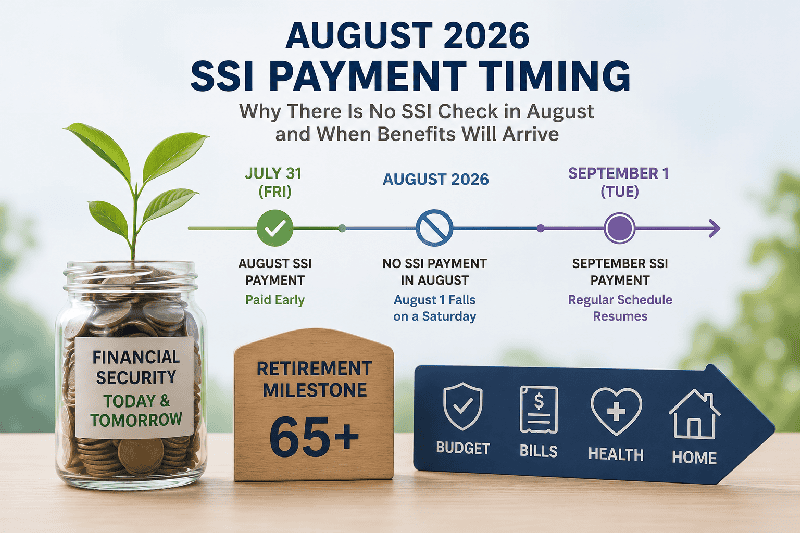
If you receive Supplemental Security Income (SSI), you may notice something unusual in August 2026: there is no SSI payment deposited during the month.
This can be alarming if you are expecting your regular monthly benefit. However, in most cases, it does not mean your payment was missed, reduced, or stopped. Instead, it happens because of the way the Social Security Administration (SSA) schedules payments when the first day of a month falls on a weekend or federal holiday.
This guide explains why there is no SSI payment in August 2026, when your money actually arrives, how it differs from regular Social Security retirement benefits, and what practical steps you can take to manage your bills and monthly budget.
What Changed?
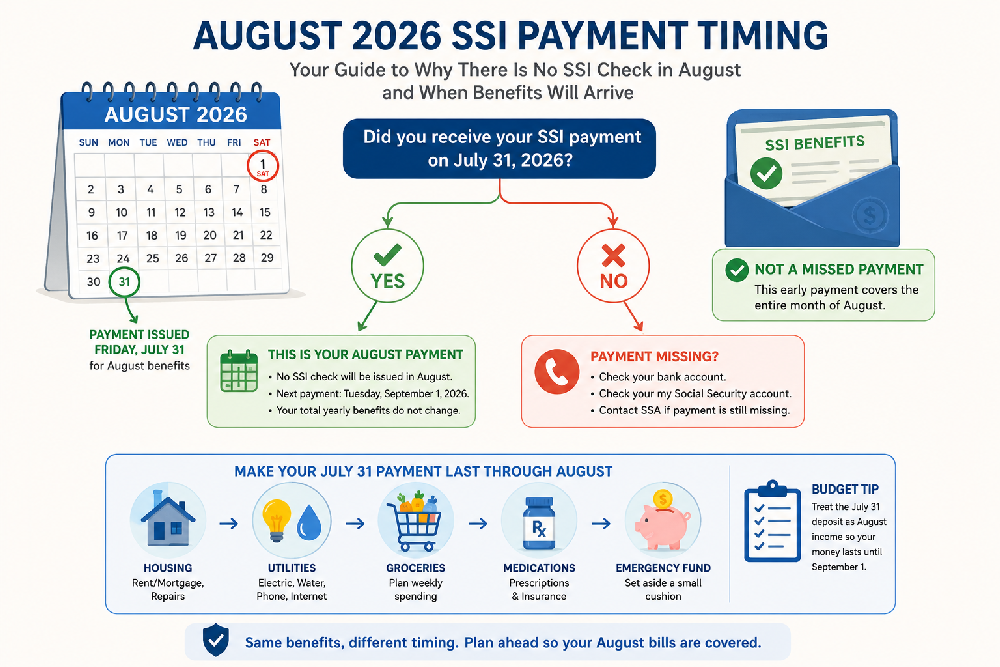
For August 2026, SSI recipients receive their monthly benefit before August begins. Because August 1, 2026 falls on a Saturday, the Social Security Administration issues the payment on the previous business day.
As a result:
- You receive your August SSI benefit near the end of July.
- There is no separate SSI deposit during August.
- Your total yearly SSI benefits do not change.
This is simply a scheduling adjustment—not an extra payment and not a reduction in benefits.
August 2026 SSI Payment Schedule
| Benefit | Scheduled Month | Payment Date | Reason |
|---|---|---|---|
| August 2026 SSI Benefit | August | Friday, July 31, 2026 | August 1 falls on a Saturday. |
| September 2026 SSI Benefit | September | Tuesday, September 1, 2026 | Regular payment schedule. |
Although there is no payment deposited during August itself, the July 31 payment is intended to cover the entire month of August.
Why Does This Happen?
The Social Security Administration generally pays SSI benefits on the first day of each month.
When that date falls on:
- a Saturday,
- a Sunday, or
- a federal holiday,
the payment is sent on the previous business day.
This policy helps recipients receive their benefits before the scheduled month begins rather than waiting until after the weekend or holiday.
It is a long-standing payment rule that affects multiple months over the years whenever the calendar requires it.
Does This Mean You Received an Extra Payment?
No.
Seeing two SSI deposits close together can make it appear that you received a bonus payment.
In reality:
- the July payment covers July,
- the July 31 payment covers August, and
- September payments return to the normal schedule.
You are simply receiving one month’s benefit slightly earlier.
How This Affects Your Monthly Budget
The biggest challenge is not the amount of money—it is the timing.
If you usually budget according to calendar months, receiving your August money at the end of July may make August seem like a month without income.
That can lead to:
- overspending during late July,
- difficulty paying August bills,
- unexpected overdraft fees,
- late payments on automatic withdrawals, and
- credit card balances increasing unnecessarily.
Treat the July 31 deposit as your August income, not extra spending money.
Practical Budgeting Tips
| Situation | Helpful Action |
|---|---|
| Automatic rent payment | Confirm enough funds remain throughout August. |
| Utility bills | Reserve part of the July 31 deposit immediately. |
| Prescription expenses | Set aside medication costs before discretionary spending. |
| Groceries | Create a weekly grocery budget covering the entire month. |
| Credit card payment | Schedule payment dates after verifying available cash. |
| Emergency expenses | Keep a small reserve instead of spending the full deposit immediately. |
What About Social Security Retirement Benefits?
Many people receive both SSI and Social Security retirement, disability, or survivor benefits.
These programs follow different payment schedules.
While SSI moves to July 31 for the August benefit, regular Social Security retirement benefits generally continue using the normal monthly schedule based on the beneficiary’s birth date.
| Birth Date | Typical August Payment Timing |
|---|---|
| 1st–10th | Second Wednesday of August |
| 11th–20th | Third Wednesday of August |
| 21st–31st | Fourth Wednesday of August |
Some beneficiaries who began receiving benefits before May 1997 or who receive both SSI and Social Security follow different payment rules.
Always verify your own payment schedule through your Social Security account or official SSA calendar.
Have Benefit Amounts Changed?
The August timing change does not automatically mean:
- your monthly benefit increased,
- your benefit decreased,
- your eligibility changed, or
- a new law affected your payments.
The payment date changed because of the calendar—not because of a policy change.
If your payment amount changes, it is usually due to factors such as:
- annual cost-of-living adjustments (COLA),
- income reporting,
- living arrangement changes,
- resource limits, or
- other eligibility updates.
Example Scenarios
Example 1: Budgeting Correctly
Maria receives SSI each month.
She notices a deposit on July 31 and initially believes she received extra money.
Instead of spending it immediately, she labels it “August Income,” pays her August rent, sets aside grocery money, and leaves enough for utilities.
As a result, she has sufficient funds throughout August despite not receiving another deposit during the month.
Example 2: Automatic Bill Payments
James has automatic withdrawals for:
- phone service,
- internet,
- electricity, and
- prescription insurance.
He verifies that enough money remains in his checking account until September 1.
This prevents overdraft fees and avoids missed payments.
Example 3: Joint SSI and Retirement Benefits
Linda receives SSI along with Social Security retirement benefits.
Her SSI arrives on July 31, while her retirement benefit still follows its normal August payment date.
Understanding that the two programs use different schedules helps her avoid confusion.
Decision Checklist
- Did you receive your SSI payment on July 31?
- Did you mistake it for an extra payment?
- Have you planned spending through the end of August?
- Do your automatic bill payments match your available balance?
- Have you checked your Social Security payment schedule separately if you receive retirement benefits?
Simple Financial Calculators
Monthly Spending Reserve
Formula:
Remaining August Funds = July 31 Deposit − Total August Bills − Planned Savings
Weekly Budget Formula
Formula:
Weekly Budget = August Available Funds ÷ Number of Weeks Remaining
Emergency Cushion Formula
Formula:
Emergency Reserve = Monthly SSI Benefit × Desired Reserve Percentage
For example, saving 10% of each month’s benefit can provide a small cushion for unexpected expenses.
Common Mistakes to Avoid
- Thinking July 31 is an extra payment.
- Spending the entire deposit before August begins.
- Ignoring automatic withdrawals scheduled during August.
- Confusing SSI payment dates with Social Security retirement payment dates.
- Assuming the timing change means benefits increased or decreased.
Frequently Asked Questions
Why is there no SSI payment during August 2026?
Because August 1 falls on a Saturday, the Social Security Administration issues the August SSI payment on Friday, July 31, 2026.
Did I lose a month’s benefits?
No. Your August benefit was simply paid early.
Is July 31 an extra SSI payment?
No. It is your regular August benefit issued before the month begins.
Will my September payment still arrive?
Yes. Assuming your eligibility remains unchanged, the September SSI payment follows the regular schedule.
Does this affect Social Security retirement benefits?
Generally, no. Retirement benefits continue following the regular monthly payment schedule based on eligibility rules and birth dates.
Should I contact Social Security if I do not receive the July 31 payment?
If you expected an SSI payment and it does not arrive, first check your bank account and your online Social Security account. If the payment is still missing after the normal processing period, contact the Social Security Administration for assistance.
Key Takeaways
The August 2026 SSI payment schedule may seem unusual, but it follows a standard Social Security Administration rule. Because August 1 falls on a Saturday, the August benefit is paid on July 31 instead of during August.
The most important financial decision is to treat that deposit as money intended for August. Planning ahead for rent, utilities, groceries, medications, and automatic payments can help prevent cash-flow problems until the next regularly scheduled benefit arrives.
References
- Social Security Administration — Understanding Supplemental Security Income (SSI) — Explains SSI eligibility, benefit rules, and payment basics.
- Social Security Administration Payment Calendar — Official payment calendar supporting scheduled SSI and Social Security payment dates.
- Social Security Administration — Supplemental Security Income (SSI) — Official overview of the SSI program and payment information.
- my Social Security — Official portal for checking personal benefit information and payment status.