
Artificial intelligence (AI) is rapidly changing the workplace. While some headlines warn that AI could eliminate entry-level jobs, others argue that it is simply changing the types of skills employers expect. For workers, students, and career changers, the most important question is not whether AI exists—it is how to adapt to it.
From a personal finance perspective, employment is one of the biggest drivers of long-term financial health. Your job affects your income, ability to pay bills, retirement savings, debt repayment, insurance benefits, and future earning potential. Understanding how AI is changing hiring can help you make better career and financial decisions.
This guide explains what is happening in today’s job market, what AI means for entry-level employment, and practical steps workers can take to improve both their career prospects and financial stability.
Personal Finance Angle
Changes in the labor market affect much more than employment statistics. They influence:
- Monthly household income
- Emergency savings
- Student loan repayment
- Retirement contributions
- Health insurance eligibility
- Career growth and future wages
Even a six-month delay in finding a job can have lasting financial consequences if savings are depleted or retirement contributions stop.
What Changed?
Recent discussions have focused on whether AI is replacing entry-level workers or simply changing the nature of entry-level work. Some experts warn that companies relying too heavily on automation could reduce opportunities for new workers and weaken future talent pipelines. Others argue that AI is becoming another workplace tool, requiring employees to develop new technical and problem-solving skills rather than eliminating jobs altogether.
At the same time, recent stories have highlighted the challenges some job seekers face during extended job searches, while others have chosen career changes that prioritize quality of life over higher salaries.
How AI Is Changing Entry-Level Jobs
Many routine tasks that were traditionally assigned to junior employees can now be completed more quickly using AI-assisted software.
Examples include:
- Drafting emails
- Summarizing documents
- Basic data analysis
- Scheduling
- Simple coding assistance
- Customer service chat responses
However, employers continue to value skills that AI cannot easily replace, including communication, critical thinking, teamwork, judgment, creativity, and customer interaction.
Personal Skills Becoming More Valuable
| Skill | Why It Matters | Can AI Fully Replace It? |
|---|---|---|
| Communication | Working with customers and teams | No |
| Problem solving | Handling unexpected situations | Limited |
| Critical thinking | Evaluating information | Limited |
| Leadership | Managing people and projects | No |
| Technical AI skills | Using AI tools effectively | Growing importance |
How Employment Affects Your Finances
Your first job often determines more than your first paycheck.
It may influence:
- Retirement account contributions
- Employer health insurance
- Professional networking
- Future promotions
- Annual raises
- Long-term lifetime earnings
Starting your career earlier also allows more years for retirement investments to grow through compound returns.
What Job Seekers Should Do
Instead of competing directly against AI, many experts recommend learning how to use AI productively.
Helpful strategies include:
- Learn one or two popular AI workplace tools.
- Build strong communication skills.
- Create a portfolio showing practical work.
- Customize each resume instead of mass applying.
- Develop industry-specific knowledge.
- Continue learning throughout your career.
Example Scenario 1
Recent College Graduate
A graduate spends six months searching for work.
Instead of waiting only for one ideal position, they:
- Complete AI-related certifications.
- Build personal projects.
- Accept freelance work.
- Continue networking.
These activities may improve employability while also generating some income.
Example Scenario 2
Career Changer
An employee earning $80,000 decides to switch careers and accepts a position paying $65,000.
Although income decreases initially, the new career offers stronger long-term demand and better advancement opportunities.
Evaluating long-term earning potential rather than focusing only on today’s salary may lead to better financial outcomes.
Financial Decisions During a Job Search
| Situation | Possible Action |
|---|---|
| Emergency savings running low | Reduce discretionary spending. |
| Student loans | Review available repayment options. |
| Health insurance ending | Compare COBRA, Marketplace, or other coverage. |
| Retirement contributions paused | Resume investing once income stabilizes. |
| Long job search | Expand industries and geographic options. |
Decision Framework
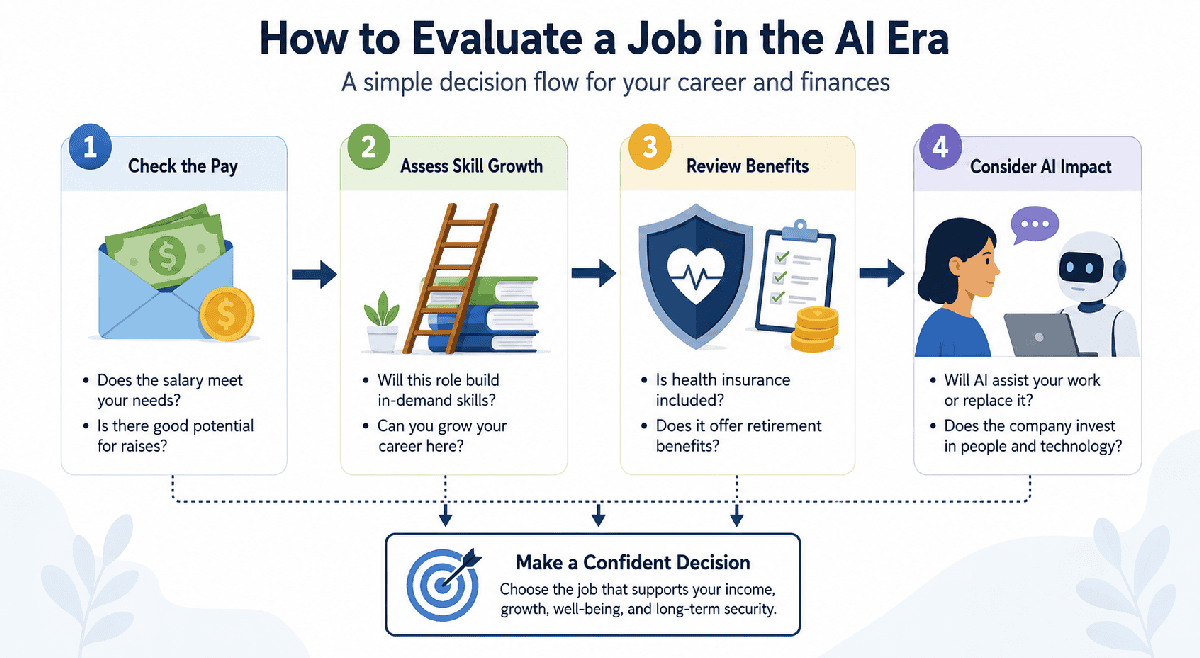
When evaluating a new job opportunity, consider more than salary.
| Question | Why It Matters |
|---|---|
| Does it build valuable skills? | Higher future earning potential. |
| Does it include retirement benefits? | Long-term wealth building. |
| Is there career advancement? | Future income growth. |
| Does it offer health insurance? | Lower financial risk. |
| Will AI likely assist rather than replace this role? | Greater long-term job security. |
Simple Financial Calculators
Emergency Fund
Formula
Emergency Fund = Monthly Essential Expenses × Number of Months Desired
Income Replacement
Formula
Income Replacement Rate = New Salary ÷ Previous Salary × 100
Retirement Savings
Formula
Annual Retirement Contribution = Monthly Contribution × 12
Questions Worth Verifying
- What do the latest labor market reports show about entry-level hiring?
- Which industries continue hiring recent graduates?
- Which occupations are seeing increased AI adoption?
- Which skills do employers currently prioritize?
- How are wages changing for entry-level workers?
Common Mistakes to Avoid
- Assuming AI will eliminate every entry-level job.
- Ignoring opportunities to learn AI tools.
- Applying to hundreds of jobs with the same resume.
- Stopping professional networking.
- Focusing only on starting salary instead of career growth.
Key Takeaways
- AI is changing many entry-level jobs rather than eliminating all of them.
- Communication, judgment, and problem-solving remain highly valuable.
- Learning to use AI can improve career opportunities.
- Employment decisions have long-term effects on retirement savings and financial security.
- Building adaptable skills is one of the best investments you can make.
Frequently Asked Questions
Will AI replace all entry-level jobs?
No. While some routine tasks may be automated, many jobs are evolving rather than disappearing. Human skills continue to be important across industries.
Should I learn AI if I am not in technology?
Yes. Many office, healthcare, education, marketing, finance, and customer service roles now use AI tools to improve productivity.
Does accepting a lower-paying job always hurt my finances?
Not necessarily. A lower-paying role that offers better long-term career growth, benefits, or stability may improve lifetime earnings.
What is the most important financial step during unemployment?
Review your emergency budget, preserve cash, understand your insurance options, and continue developing skills while searching for work.
Should I stop contributing to retirement if unemployed?
If income stops, preserving essential living expenses usually comes first. Once employment resumes, restarting retirement contributions as soon as practical can help get your long-term savings back on track.
Conclusion
AI is reshaping the workforce, but it is also creating new opportunities for workers who continue learning and adapting. Instead of viewing AI only as a threat, consider how it can become another tool that helps improve productivity and career development.
For most people, the best financial strategy is to invest in transferable skills, maintain an emergency fund, continue networking, and make career decisions based on long-term earning potential rather than short-term headlines. Building resilience—both professionally and financially—can help you navigate an evolving job market with greater confidence.
References
- U.S. Bureau of Labor Statistics (BLS) – Official employment, wage, and labor market statistics supporting discussion of hiring trends.
- O*NET Online – Occupational skill profiles and information on job requirements and workplace tasks.
- CareerOneStop – U.S. Department of Labor resource covering career planning, training, and job search guidance.
- Organisation for Economic Co-operation and Development (OECD) Employment – Research on labor markets, skills, and the impact of technology on employment.
- World Economic Forum – Future of Work – Reports and analysis on workforce trends, AI adoption, and emerging job skills.