
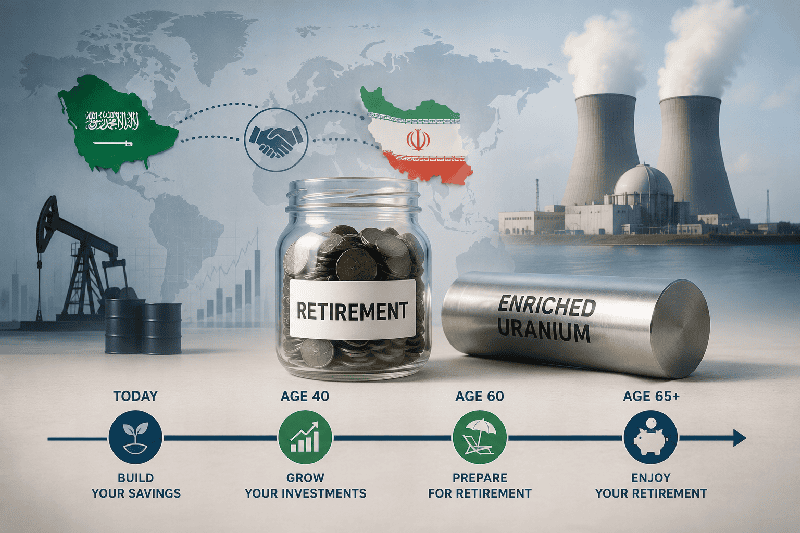
Enriched uranium has become a major topic in international news as governments discuss nuclear agreements, regional security, and energy policy. While the headlines often focus on diplomacy and geopolitics, many people wonder what any of this means for their own finances.
The answer is that developments involving enriched uranium can influence global energy prices, stock market volatility, inflation expectations, and investment performance. These effects can eventually reach household budgets through gasoline prices, utility bills, retirement accounts, and consumer confidence.
This guide explains what enriched uranium is, why Saudi Arabia and Iran are currently in the news, and what practical financial implications everyday readers should consider.
What Is Enriched Uranium?
Natural uranium contains only a small percentage of the isotope uranium-235, which can sustain a nuclear chain reaction. Enrichment is the process of increasing the concentration of uranium-235.
Different enrichment levels serve different purposes:
| Enrichment Level | Typical Purpose | General Notes |
|---|---|---|
| Low-enriched uranium (LEU) | Commercial nuclear power plants | Commonly used for electricity generation. |
| Higher enrichment | Research and specialized applications | Subject to stricter international oversight. |
| Weapons-grade enrichment | Nuclear weapons | Highly restricted and monitored internationally. |
International organizations closely monitor enrichment activities because they have implications for nuclear security and non-proliferation agreements.
Personal Finance Angle
Although enriched uranium may appear unrelated to household finances, geopolitical developments involving nuclear programs can affect financial markets in several ways:
- Oil prices may rise if tensions threaten energy supplies.
- Higher fuel costs can increase transportation expenses.
- Inflation may remain elevated if energy prices stay high.
- Energy-sector stocks may experience greater volatility.
- Retirement portfolios containing broad index funds may fluctuate with market sentiment.
These effects usually matter more than the political headlines themselves.
What Changed?
Recent attention has focused on reports that a proposed U.S.-Saudi civilian nuclear agreement allowing uranium enrichment remains under review. At the same time, discussions surrounding Iran’s enriched uranium inventory and possible diplomatic negotiations continue to influence investor sentiment.
Markets often react less to a single announcement than to whether negotiations appear to reduce or increase geopolitical uncertainty.
Why Energy Markets Pay Attention
The Middle East remains one of the world’s most important energy-producing regions. Although enriched uranium itself is not directly connected to oil production, political developments involving major regional powers can affect expectations about:
- Oil exports
- Shipping routes
- Natural gas supplies
- Global economic growth
- Business investment
Even if no actual disruption occurs, investor expectations alone can move commodity prices.
Potential Financial Effects
| Area | Possible Impact | What Consumers Can Watch |
|---|---|---|
| Gasoline | Fuel prices may become more volatile. | Monthly transportation budget. |
| Utilities | Higher natural gas prices may influence heating and electricity costs. | Seasonal utility bills. |
| Inflation | Energy costs can affect prices across many industries. | Overall household spending. |
| Investments | Energy companies and commodity ETFs may fluctuate. | Portfolio diversification. |
| Retirement Accounts | Broad stock indexes may react to changing market sentiment. | Long-term investment strategy. |
What Investors Should Watch
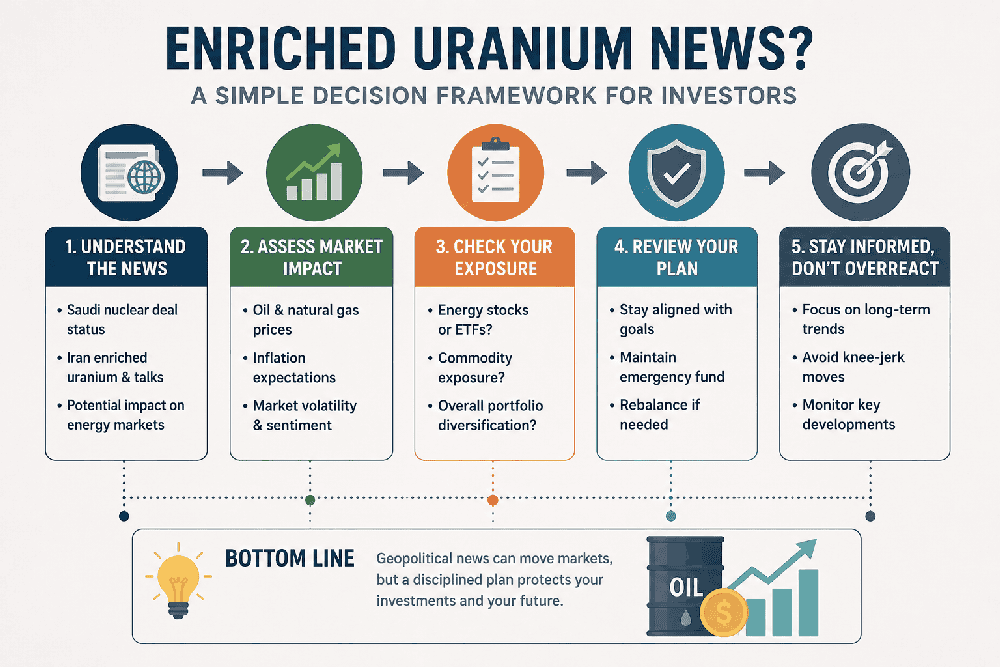
Rather than reacting immediately to breaking headlines, investors may find it more useful to monitor broader economic indicators.
- Oil prices
- Natural gas prices
- Inflation reports
- Treasury yields
- Federal Reserve policy expectations
- Major energy company earnings
These factors often have a larger long-term impact on investment returns than short-lived geopolitical news.
Should Investors Buy Energy Stocks?
Some investors assume geopolitical tensions automatically make energy stocks attractive. In reality, markets often price in expectations before retail investors react.
Instead of chasing headlines, consider questions such as:
- Does the investment fit your long-term goals?
- Are you already heavily exposed through index funds?
- Can you tolerate short-term volatility?
- Would diversification provide better risk management?
Example Scenario 1
A Family Budget
A household spends approximately $300 each month on gasoline.
If oil prices increase enough to raise gasoline costs by 10%, monthly fuel spending becomes roughly $330.
That extra $30 per month equals approximately $360 annually.
While the exact amount varies, this example illustrates how energy price changes can affect annual household expenses.
Example Scenario 2
A Retirement Investor
An investor owns a diversified S&P 500 index fund inside a retirement account.
Following geopolitical news, markets experience short-term volatility.
Instead of selling immediately, the investor reviews:
- Asset allocation
- Emergency savings
- Investment time horizon
- Overall diversification
For long-term investors, these factors are usually more important than reacting to daily headlines.
Decision Framework
| If… | Consider… |
|---|---|
| You commute long distances. | Preparing for possible fuel price increases. |
| You own energy-sector investments. | Reviewing concentration risk. |
| You are retired. | Ensuring sufficient cash reserves for higher living costs. |
| You invest monthly. | Continuing disciplined investing instead of timing markets. |
| You have variable-rate debt. | Monitoring inflation and interest-rate expectations. |
Simple Financial Calculators
Annual Fuel Cost
Formula
Annual Fuel Cost = Monthly Fuel Spending × 12
Energy Price Increase
Formula
New Cost = Original Cost × (1 + Percentage Increase)
Portfolio Energy Exposure
Formula
Energy Allocation (%) = Energy Investments ÷ Total Portfolio × 100
Questions Worth Verifying
- Has the proposed U.S.-Saudi nuclear agreement been officially approved or delayed?
- What is the latest status of international negotiations involving Iran?
- Have oil prices reacted significantly to recent developments?
- Are shipping routes or global energy supplies being disrupted?
- Have major energy companies revised earnings guidance because of geopolitical events?
Key Takeaways
- Enriched uranium is primarily a geopolitical and energy-policy issue.
- Its financial effects usually occur indirectly through energy markets.
- Oil prices, inflation, and investor sentiment often matter more than individual headlines.
- Diversification generally remains more effective than reacting to breaking news.
- Long-term financial plans should rarely change because of a single geopolitical event.
Frequently Asked Questions
Does enriched uranium directly affect gasoline prices?
No. However, geopolitical tensions involving countries in major energy-producing regions can influence oil markets, which may eventually affect gasoline prices.
Should I sell my investments because of nuclear negotiations?
Many financial professionals recommend evaluating long-term goals and diversification before making investment decisions based on short-term news.
Can these developments affect inflation?
Potentially. Higher energy prices can contribute to broader inflation because transportation and production costs influence many goods and services.
Will electricity prices increase?
They could, depending on regional fuel sources and wholesale energy markets. Electricity prices are influenced by many factors beyond geopolitical developments.
Why do financial markets react so quickly?
Markets attempt to price future expectations. Investors respond not only to current events but also to potential economic consequences.
Conclusion
News about enriched uranium often appears technical and distant from everyday life, but it can influence financial markets through expectations about energy supplies, inflation, and geopolitical stability. For most households, the practical effects are more likely to appear in fuel costs, utility bills, and retirement account performance than through direct exposure to nuclear policy.
Rather than reacting emotionally to breaking headlines, focus on maintaining a diversified investment strategy, monitoring your household budget, and reviewing how energy costs fit into your long-term financial plan.
References
- International Atomic Energy Agency (IAEA) – Explains uranium enrichment, nuclear safeguards, and international monitoring.
- U.S. Department of Energy – Provides information on nuclear energy, uranium, and the U.S. energy system.
- U.S. Energy Information Administration (EIA) – Supports discussion of oil markets, energy prices, and energy market data.
- World Nuclear Association – Provides background on uranium enrichment and commercial nuclear fuel.
- International Monetary Fund (IMF) – Supports discussion of how energy prices and geopolitical events can influence inflation and the global economy.