

Jeff Bezos is back in the headlines. Recent stories have focused on his comments about taxing expensive second homes, his changing position among the world’s richest people, his influence at Amazon, and continued changes at The Washington Post.
These stories may be interesting, but they do not all deserve the same financial reaction. A billionaire’s estimated wealth can change by billions of dollars in one day without changing the average household’s tax bill, grocery budget, or retirement plan. A public comment about taxes may start a political debate without creating a new law. A leadership change at a newspaper may matter to employees and subscribers but have little direct effect on Amazon’s profits.
The practical question is not simply, “What did Jeff Bezos say?” It is, “Does this development change any decision I need to make with my money?”
Why Jeff Bezos Is Receiving New Attention
Several separate developments have pushed searches for Jeff Bezos higher.
First, Bezos entered a public debate over a proposed New York City tax on high-value second homes. He indicated that taxing luxury properties could be reasonable, while also warning that taxes can become counterproductive when rates rise enough to discourage economic activity. His comparison to hotel taxes attracted attention because it touched on a larger argument about how cities should raise revenue from wealthy residents, visitors, and property owners.
Second, changes in Amazon’s share price moved Bezos higher in real-time billionaire rankings. Those rankings can change quickly because a large part of his estimated fortune is connected to Amazon stock. When Amazon shares rise, the estimated value of his remaining holdings may rise as well.
Third, Bezos continues to attract coverage because of his real estate, private companies, media ownership, and role as Amazon’s executive chair. Recent leadership changes at The Washington Post have renewed debate about his influence over the newspaper.
These are related through Bezos, but they are not one financial story. Readers should evaluate each item separately.
What Bezos’ Tax Comments Actually Mean for Your Finances
A public statement from a wealthy business owner does not change anyone’s tax obligation. Taxes change when lawmakers approve legislation and the appropriate government authority puts it into effect.
The proposal discussed in connection with Bezos concerns expensive properties that are not used as an owner’s primary home. That is very different from a broad increase in federal income taxes, sales taxes, or ordinary homeowner property taxes.
| Headline | What it may affect | What it does not automatically affect |
|---|---|---|
| Bezos comments on a luxury-home tax | Political debate, high-end property owners, local real estate decisions | Your federal tax return, paycheck withholding, or ordinary household budget |
| A city proposes a new tax | People and properties covered by the final law | Residents outside that jurisdiction |
| A billionaire criticizes or supports a tax | Public opinion and lobbying pressure | The legal tax rate until legislation is enacted |
For most readers, the useful lesson is to distinguish a proposal from an enacted rule. Before changing a home purchase, investment, or relocation plan, check four details:
- Has the proposal become law?
- What property values, income levels, or transactions does it cover?
- When would it take effect?
- Are there exemptions for primary residences or certain owners?
Do not assume a widely shared political comment means your own taxes are about to rise.
Why Bezos’ Wealth Ranking Can Move So Quickly
Billionaire rankings are estimates, not bank-account balances. They usually combine the estimated value of publicly traded stock, private businesses, real estate, cash, and other assets. Debts may also be subtracted when reliable information is available.
Bezos’ position can change sharply because Amazon is a large public company and he still owns a significant stake. A strong day for Amazon stock can add billions of dollars to his estimated net worth on paper. A price decline can remove billions just as quickly.
Suppose a person owns 900 million shares of a company. A $5 increase in the stock price would raise the market value of those holdings by:
900 million shares × $5 = $4.5 billion
That does not mean the owner received $4.5 billion in cash. Selling a large number of shares could create taxes, affect the share price, and require regulatory disclosures. The wealth estimate mainly reflects what the stake is worth at the current market price.
This distinction matters for everyday investors. A headline saying Bezos gained billions does not prove that Amazon suddenly earned billions more in operating profit. It may simply mean the stock market placed a higher value on the company.
What Amazon Investors Should Watch Instead
Investors should not buy or sell Amazon stock because Bezos moved from fourth to third on a rich list. The more useful information is found in Amazon’s financial results and business outlook.
Amazon recently reported strong growth in Amazon Web Services, its cloud-computing division. The company also increased its planned spending on artificial intelligence, data centers, chips, logistics, and other technology. That combination creates both opportunity and risk.
Strong cloud growth may support future revenue and profits. At the same time, very high capital spending can reduce free cash flow in the near term. Free cash flow is the money remaining after a company pays operating expenses and invests in property and equipment. Investors often watch it because it can be used for debt reduction, acquisitions, share repurchases, or other corporate needs.
| Factor to review | Why it matters |
|---|---|
| AWS sales growth | Cloud computing is a major source of Amazon’s operating profit. |
| AI and data-center spending | Heavy investment may support future growth but can pressure cash flow. |
| Retail operating margins | Small improvements can have a large effect because Amazon sells at enormous scale. |
| Advertising growth | Advertising can be more profitable than basic online retail sales. |
| Stock valuation | A strong company can still be a risky investment when expectations are too high. |
Bezos remains Amazon’s founder and executive chair, but Andy Jassy has served as chief executive since 2021. Investors should therefore pay attention to current management’s strategy, official earnings releases, regulatory filings, and conference calls rather than treating every Bezos headline as a direct Amazon trading signal.
Should You Buy Amazon Because Bezos Is Getting Richer?
No single person’s wealth ranking is a sound investment thesis. A better decision framework starts with your own finances.
1. Check your emergency savings
Money needed for rent, medical costs, car repairs, or other near-term bills usually should not be placed in a volatile individual stock. A stock can fall at the exact time you need the cash.
2. Pay attention to high-interest debt
Paying down a credit card charging 20% or more provides a predictable financial benefit. Buying Amazon shares offers no guaranteed return. The stock could rise, remain flat, or decline.
3. Review concentration risk
You may already have Amazon exposure through an S&P 500 fund, a total-market fund, or a technology-focused retirement plan. Adding individual shares can make your portfolio more dependent on one company.
4. Decide how much loss you could tolerate
Imagine the stock falling 30%. Would you remain invested, or would fear cause you to sell? Your answer may reveal whether the position is too large.
A simple approach is to keep speculative or individual-stock positions to a limited portion of a diversified portfolio. The appropriate amount depends on your goals, time horizon, and ability to accept losses.
What the Headlines Mean for Amazon Customers
For consumers, Bezos’ personal wealth has almost no direct connection to the price of an item in an Amazon shopping cart. Product prices are influenced by sellers, competition, shipping expenses, advertising, demand, and Amazon’s marketplace policies.
Customers should focus on choices they can control:
- Compare Amazon’s price with other retailers before buying.
- Check whether a search result is sponsored rather than the best-value option.
- Include shipping charges and membership fees in the total cost.
- Avoid buying extra items merely to justify a Prime subscription.
- Review recurring subscriptions and automatic deliveries regularly.
For example, a $139 annual membership costs about $11.58 per month when spread across a year. A household that rarely uses shipping, streaming, or other included services may not receive enough value. A household that uses those benefits often may save more than the fee. The decision should be based on actual use, not on news about Amazon’s founder.
Do Bezos’ Media and Real Estate Stories Affect Investors?
Bezos owns The Washington Post personally rather than through Amazon. Changes at the newspaper can matter greatly to its workers, readers, and the media industry, but they should not automatically be treated as changes in Amazon’s financial position.
The same separation applies to Bezos’ homes, Blue Origin, and other private interests. A purchase or management decision involving one of those assets is not necessarily an Amazon expense or investment.
This is a common mistake when following famous founders. The person, the public company, and privately owned ventures may be connected in reputation, but they are legally and financially different.
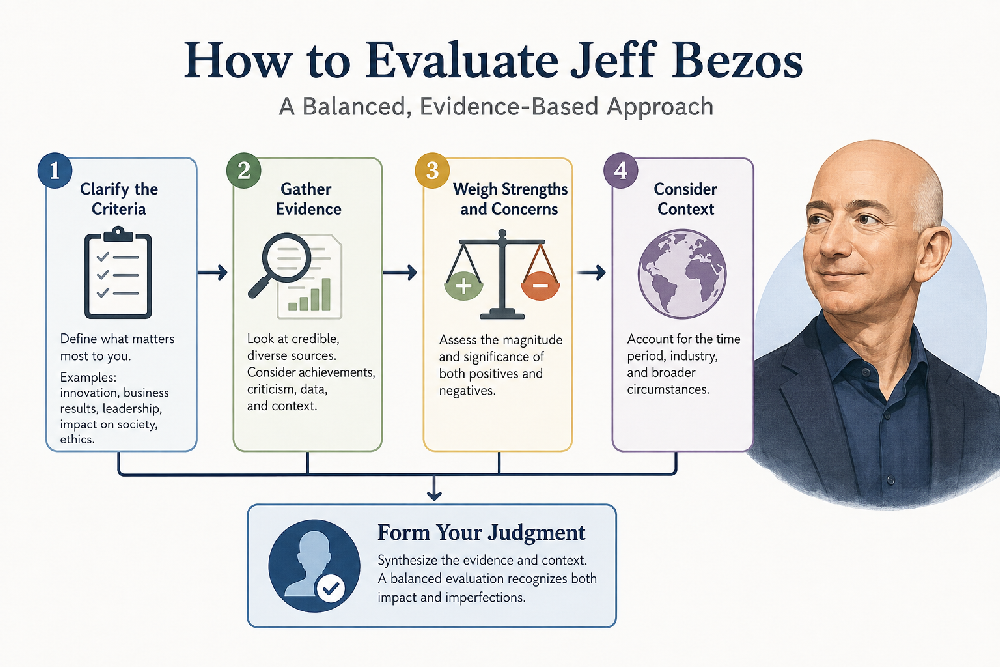
A Practical Headline Test
Before acting on the next Jeff Bezos story, ask these questions:
- Is this about Bezos personally or Amazon as a public company?
- Is the story describing a proposal, an opinion, or a completed action?
- Does it change Amazon’s revenue, expenses, cash flow, leadership, or legal risk?
- Does it affect a tax or consumer rule that applies to me?
- Am I considering a financial move because of evidence or because the headline feels dramatic?
If the story does not change your income, expenses, taxes, investment thesis, or risk level, the best financial response may be no response at all.
Frequently Asked Questions
Did Jeff Bezos announce a new tax?
No. Bezos commented on a proposed tax policy. He does not have the authority to create a city or federal tax. Any actual change would need to go through the relevant legislative and legal process.
Why does Jeff Bezos’ net worth change every day?
A large part of his estimated wealth is linked to assets whose values move, especially Amazon stock. Real-time rich lists adjust their estimates as market prices change.
Does a rise in Bezos’ wealth mean Amazon is more profitable?
Not necessarily. The stock price may rise because investors expect stronger future growth, because of a favorable earnings report, or because of broader market conditions. Profit and market value are related, but they are not the same thing.
Is Amazon stock a safe retirement investment?
Amazon is a large, established company, but its stock can still be volatile. Holding too much of any single stock can create concentration risk. Many retirement investors use diversified funds to spread risk across hundreds or thousands of companies.
Should consumers cancel Prime because Bezos is wealthy?
Wealth alone is not a useful reason to keep or cancel a subscription. Review how often you use the benefits and compare the value you receive with the annual cost.
The Bottom Line
Jeff Bezos’ tax comments, wealth ranking, real estate, and media influence create attention because they combine money, power, and public policy. Yet most of these headlines do not require an immediate change to your household finances.
Tax comments matter only if they contribute to a law that applies to you. Billionaire rankings are volatile estimates rather than proof of cash income. Amazon investors should study business performance, valuation, cash flow, and risk. Amazon customers should compare prices and judge whether paid services provide real value.
The best response to a high-profile financial headline is often to slow down. Separate Bezos from Amazon, opinions from laws, and paper wealth from business results. Then make decisions based on your own budget, debt, savings, goals, and tolerance for investment losses.
References
- Amazon Second-Quarter 2026 Results — Supports the discussion of Amazon’s recent sales, earnings, AWS performance, and investment activity.
- Amazon 2025 Annual Report filed with the SEC — Supports information about Amazon’s leadership structure, business risks, financial reporting, and Bezos’ role as executive chair.
- Amazon Annual Reports and Proxy Statements — Provides official corporate filings and shareholder materials for evaluating management, ownership, and company strategy.
- Forbes Real-Time Billionaires List — Supports the explanation that billionaire rankings and estimated net worth can move as public asset prices change.
- Internal Revenue Service Filing Guidance — Provides official federal tax information and reinforces the distinction between public tax commentary and rules that actually apply to taxpayers.