
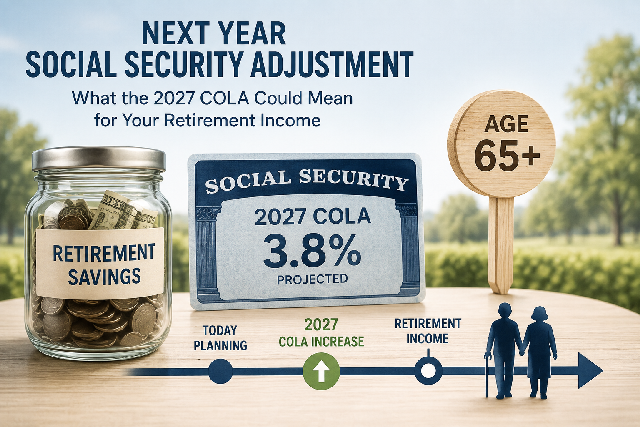
The next year Social Security adjustment is attracting attention because early forecasts point to a larger increase in 2027 than beneficiaries received in 2026. One widely followed estimate currently projects a 3.8% cost-of-living adjustment, or COLA.
That number is not final. The Social Security Administration will calculate the official adjustment after inflation figures for July, August, and September 2026 are available. Until then, forecasts can move higher or lower.
Even so, estimating the possible increase can help retirees plan ahead. A higher monthly check may provide some relief from rising food, housing, utility, and medical costs. But Medicare premiums, taxes, and continued inflation could reduce how much of the increase is actually available to spend.
What Is the Expected Social Security Adjustment for 2027?
As of July 2026, The Senior Citizens League estimates that the 2027 Social Security COLA could be about 3.8%. This would be one percentage point higher than the 2.8% adjustment applied to 2026 benefits.
The estimate should be treated as a planning figure, not a guaranteed raise. The final percentage depends on inflation during the third quarter of 2026. Energy prices, food costs, rent, transportation expenses, and other price changes can influence the final calculation.
Forecasts have shifted during the year as inflation conditions changed. That is normal. Before the third-quarter data are complete, analysts must estimate where consumer prices are headed rather than calculate the actual adjustment.
| Item | Current information |
|---|---|
| 2026 Social Security COLA | 2.8% |
| Current 2027 forecast | About 3.8% |
| Official calculation period | July through September 2026 |
| Expected announcement | October 2026 |
| Higher retirement payments begin | January 2027 |
How Social Security Calculates the COLA
Social Security does not set the COLA based on a political promise, a retiree survey, or the general inflation rate reported in headlines. The calculation uses the Consumer Price Index for Urban Wage Earners and Clerical Workers, commonly called the CPI-W.
The government compares the average CPI-W for July, August, and September of the current year with the average from the same three months in the last year that produced a COLA. The percentage increase becomes the next adjustment, rounded to the nearest tenth of one percent.
A simplified version of the calculation is:
COLA = (Current third-quarter CPI-W average − previous third-quarter CPI-W average) ÷ previous average × 100
The September 2026 inflation report is scheduled for release on October 14, 2026. Once that number is available, the full third-quarter comparison can be completed. The Social Security Administration normally announces the new COLA shortly after the necessary data are released.
How Much Could Your Monthly Benefit Increase?
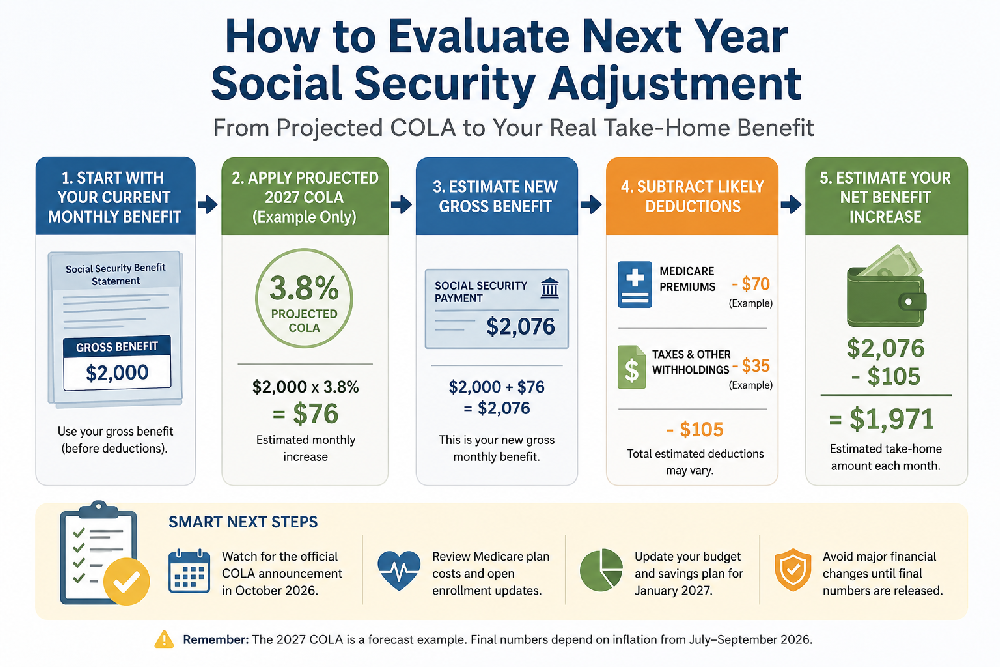
You can estimate your possible 2027 payment by multiplying your current gross monthly benefit by the projected COLA. Use the benefit before Medicare or tax deductions, not necessarily the amount deposited into your bank account.
For a 3.8% estimate:
Current monthly benefit × 0.038 = estimated monthly increase
For example, someone receiving a gross benefit of $2,000 per month would calculate:
$2,000 × 0.038 = $76
The estimated new gross benefit would be approximately $2,076 per month, or $912 more over a full year.
| Current monthly benefit | Estimated increase at 3.8% | Estimated 2027 monthly benefit |
|---|---|---|
| $1,000 | $38 | $1,038 |
| $1,500 | $57 | $1,557 |
| $2,000 | $76 | $2,076 |
| $2,500 | $95 | $2,595 |
| $3,000 | $114 | $3,114 |
These are simple estimates. Social Security applies the COLA to a person’s underlying benefit amount and follows its own rounding rules. Your official notice may therefore show a slightly different result.
Why a Larger COLA Is Not Free Money
A larger adjustment may sound like good news, but it generally means prices have also risen. The COLA is designed to help benefits keep pace with inflation. It is not intended to create a major increase in purchasing power.
Suppose your benefit rises by $76 per month. If groceries, utilities, insurance, and medical expenses have increased by a combined $70 per month, your practical improvement is only $6. Some retirees may still fall behind if the expenses they face rise faster than the CPI-W.
This is an important limitation. The CPI-W reflects spending by urban workers, not specifically older households. Retirees often devote a larger share of their income to healthcare and housing, so their personal inflation rate may differ from the number used for the COLA.
Medicare Premiums Could Reduce the Increase
Many people have Medicare Part B premiums deducted directly from Social Security. If the Part B premium rises in 2027, the increase will reduce the amount of the COLA that reaches a beneficiary’s bank account.
For example, imagine that your gross Social Security benefit rises by $76 per month but your Medicare premium increases by $7. Your net improvement before taxes or other deductions would be about $69.
Medicare costs for 2027 are not all final yet. Beneficiaries should avoid building a budget around an unofficial premium estimate. Review the official Medicare figures when they are released, then compare them with your Social Security COLA notice.
People with higher incomes may also pay an income-related monthly adjustment amount, known as IRMAA, on top of their standard Part B and Part D premiums. These surcharges are generally based on tax-return income from two years earlier.
Could the COLA Make More of Your Benefits Taxable?
Social Security benefits are not automatically tax-free. Depending on your combined income, up to 50% or 85% of your benefits may be included in taxable income.
For this purpose, combined income generally includes adjusted gross income, tax-exempt interest, and half of your Social Security benefits. The federal income thresholds are not automatically increased each year for inflation.
As a result, a COLA can push some households closer to a tax threshold even when their buying power has not meaningfully improved. This is sometimes called bracket creep.
A higher benefit does not mean you will pay tax on the entire check. It means a larger portion could be included in the income used to calculate your federal tax bill. State treatment varies. Many states do not tax Social Security, while others apply their own rules.
Retirees who take withdrawals from traditional retirement accounts should consider how those withdrawals interact with Social Security income. Before making a large withdrawal, Roth conversion, or investment sale, it may be useful to estimate the tax effect for the full year.
How to Prepare Your 2027 Retirement Budget
The best approach is to use the projected adjustment as a range rather than treating 3.8% as certain. You might prepare one budget using a 3% COLA and another using 4%. This shows whether your plan still works if the final number differs from today’s estimate.
Start with your expected gross benefit. Then subtract likely Medicare premiums, tax withholding, and other deductions. The remaining amount is closer to the money you will actually receive.
Next, compare the increase with expenses that are likely to change in January. These may include rent, property taxes, supplemental insurance, prescription coverage, utilities, and debt payments with variable interest rates.
Consider giving the expected increase a specific job:
- Rebuild cash savings used for medical or home expenses.
- Pay down credit-card debt carrying a high interest rate.
- Increase the amount reserved for prescriptions and insurance.
- Cover higher grocery or utility bills without using savings.
- Add a small amount to an emergency fund each month.
Avoid committing the entire projected raise to a new recurring expense before the official percentage and Medicare premiums are known.
What Future Retirees Should Consider
People who have not claimed Social Security may wonder whether a larger 2027 COLA means they should apply early. The COLA alone is usually not a good reason to change a claiming decision.
Eligible future beneficiaries generally receive applicable COLAs even if they have not started collecting payments. Meanwhile, claiming before full retirement age can permanently reduce the monthly benefit. Delaying beyond full retirement age can increase the benefit until age 70.
The better decision depends on health, life expectancy, employment, savings, spouse benefits, taxes, and the need for immediate income. A temporary inflation forecast should not replace a long-term claiming analysis.
What Beneficiaries Should Do Before October
There is no application required to receive the annual COLA. Social Security applies it automatically to eligible benefits.
Before the official announcement, beneficiaries can check that their mailing address, direct-deposit information, and online Social Security account are current. They can also list their current deductions so they are ready to compare the gross increase with the actual January deposit.
Be cautious of messages claiming that you must pay a fee, provide banking credentials, or click a special link to activate the increase. A legitimate COLA does not require an enrollment payment.
It is also wise to wait before changing tax withholding or spending plans. The most useful planning sequence is to review the official COLA in October, check Medicare plan choices during open enrollment, read the benefit notice when it becomes available, and finalize the household budget after all major deductions are known.
Frequently Asked Questions
Is the 2027 Social Security COLA officially 3.8%?
No. The 3.8% figure is a forecast based on current inflation information. The official percentage cannot be calculated until the July, August, and September 2026 CPI-W figures are available.
When will the 2027 COLA be announced?
The announcement is expected in October 2026. The September consumer-price report is scheduled for October 14, giving the government the final month needed for the calculation.
When will beneficiaries receive the higher payment?
Social Security retirement, survivor, and disability payments reflecting the COLA are generally paid beginning in January 2027. Supplemental Security Income payment timing may differ because of the calendar and holiday schedule.
Does everyone receive the same dollar increase?
No. The same percentage is applied, but the dollar increase depends on the person’s benefit. A 3.8% adjustment adds $38 to a $1,000 benefit and about $114 to a $3,000 benefit before rounding and deductions.
Will Medicare take the entire COLA?
That will depend on the beneficiary’s Social Security amount and Medicare premiums. A premium increase could absorb part of the raise, but the effect will vary. Certain protections may limit how much some beneficiaries’ Part B deductions can rise.
Should I claim Social Security now to receive the 2027 COLA?
Not solely for that reason. COLAs are generally reflected in the benefit calculations of eligible people who delay claiming. Evaluate the permanent effect of your claiming age before making a decision.
The Bottom Line
The next year Social Security adjustment could be larger than the 2026 increase, with a current forecast near 3.8%. For someone receiving $2,000 per month, that would suggest an increase of roughly $76 before Medicare premiums, taxes, and other deductions.
The final number remains uncertain until third-quarter inflation data are complete. Use the estimate for flexible planning, not as money already promised. The most important figure will not be the headline percentage alone. It will be the change in your net deposit after healthcare costs and taxes, compared with the increase in your actual household expenses.
References
- Social Security Administration: Cost-of-Living Adjustment Information — Explains official COLA announcements, benefit notices, and how annual increases affect payments.
- Social Security Administration: Latest COLA — Confirms the current 2026 adjustment and its effective date.
- Social Security Administration: CPI-W Data — Provides the inflation index used to calculate Social Security cost-of-living adjustments.
- U.S. Bureau of Labor Statistics: CPI Release Schedule — Supports the dates when the remaining 2026 inflation reports are scheduled for publication.
- The Senior Citizens League: COLA Watch — Provides the current independent projection for the 2027 Social Security adjustment.
- Internal Revenue Service: Social Security Income FAQs — Explains when Social Security benefits may become part of taxable income.