
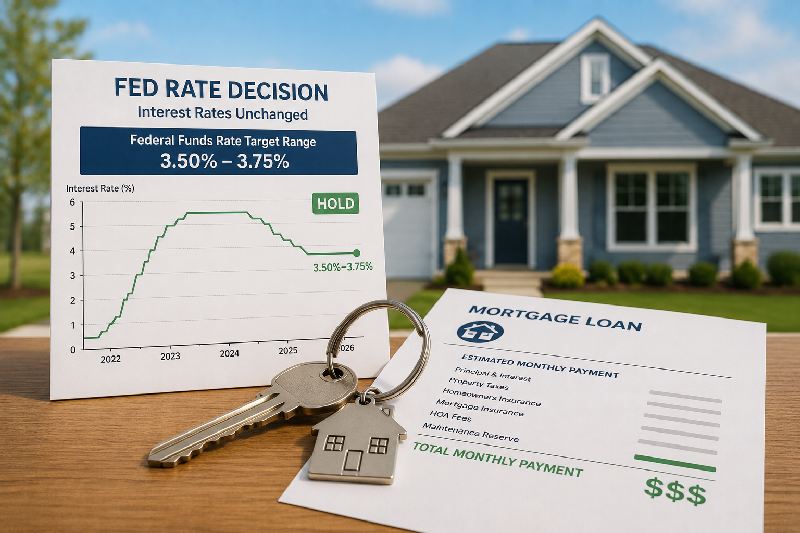
The Federal Reserve kept its benchmark interest rate unchanged at its July 29, 2026 meeting. The target federal funds rate remains between 3.50% and 3.75%.
A rate hold may sound like nothing changed. For households, however, it means borrowing costs are likely to remain relatively high for now. Credit card balances may stay expensive. Mortgage rates may not fall quickly. At the same time, savers may continue to find attractive yields on high-yield savings accounts and certificates of deposit.
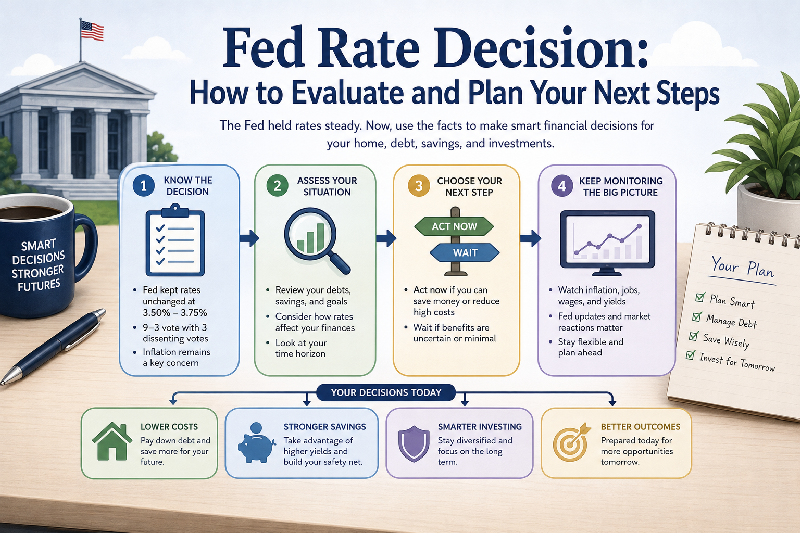
The decision was also more divided than a routine hold. The Federal Open Market Committee approved it by a 9-3 vote. Three members preferred a quarter-percentage-point increase. That disagreement matters because it suggests the next move is not automatically a rate cut. Depending on inflation, employment, energy prices, and economic growth, policymakers could continue holding rates or consider an increase.
What the latest Fed rate decision changed
The Fed did not raise or lower its policy rate. It maintained the 3.50% to 3.75% target range that had been in place since December 2025.
The federal funds rate is the rate banks use when lending reserve balances to one another overnight. Consumers do not borrow directly at this rate. Still, it influences many other rates throughout the economy.
Changes in Fed policy can affect:
- Credit card annual percentage rates, or APRs
- Home equity lines of credit
- Some adjustable-rate mortgages
- Auto and personal loan pricing
- Savings account and CD yields
- Bond prices and Treasury yields
- Stock valuations and investor risk appetite
The Fed said the economy remained resilient, employment conditions were broadly stable, and inflation was still a concern. Chair Kevin Warsh emphasized the Fed’s commitment to returning inflation to its 2% goal.
For consumers, the message is simple: do not build a financial plan that depends on a large, immediate drop in interest rates.
How the rate hold affects your mortgage
Mortgage rates are not set directly by the Federal Reserve. Fixed mortgage rates are influenced more heavily by longer-term bond yields, inflation expectations, economic growth, and investor demand for mortgage-backed securities.
That means a Fed hold does not guarantee that 30-year mortgage rates will remain unchanged. Rates can rise or fall before the next Fed meeting as investors react to new inflation reports, employment data, government borrowing, and global events.
For homebuyers
Waiting for the Fed to cut rates can be risky if you have found an affordable home that meets your needs. Home prices, inventory, taxes, insurance costs, and your personal timeline may matter more than trying to predict the exact bottom in mortgage rates.
Before buying, calculate the full monthly housing cost, including:
- Mortgage principal and interest
- Property taxes
- Homeowners insurance
- Mortgage insurance, when required
- Homeowners association fees
- A repair and maintenance allowance
A lender may approve you for more than your budget can comfortably handle. Base the decision on your monthly cash flow, not only the maximum loan amount offered.
For current homeowners
A refinance may make sense when the monthly savings are large enough to recover the closing costs within a reasonable period.
For example, assume refinancing would cost $5,000 and reduce your payment by $200 per month:
Break-even period = $5,000 ÷ $200 = 25 months
You would need to keep the new loan for a little more than two years before the monthly savings recover the upfront cost. If you expect to move or pay off the mortgage sooner, refinancing may not be worthwhile.
Do not refinance solely because a lender advertises a lower rate. Compare the APR, fees, loan term, total interest, and whether restarting a 30-year schedule would increase your long-term cost.
What it means for credit cards and other variable debt
Most credit card rates are variable. They are commonly based on the prime rate plus a margin set by the card issuer. Because the prime rate often moves with the Fed’s benchmark rate, a rate hold generally means existing card APRs will remain high unless the issuer changes the account terms or the borrower qualifies for a lower-cost option.
Consider a $6,000 balance at a 22% APR. A rough estimate of one month’s interest is:
$6,000 × 22% ÷ 12 = $110
That is approximately $110 in interest for one month before accounting for new purchases, payments, and the card issuer’s daily balance method.
If the APR eventually fell by one percentage point, the rough monthly interest would become:
$6,000 × 21% ÷ 12 = $105
The savings would be only about $5 per month. This shows why waiting for the Fed may not be the best debt strategy. Paying down the balance can save much more than a small future rate reduction.
People with strong credit may consider a balance-transfer offer or lower-rate personal loan. Review transfer fees, promotional deadlines, and the regular APR that begins when the offer expires.
Auto loans and personal loans may remain costly
Auto loan rates depend on more than Fed policy. Your credit score, loan term, down payment, vehicle age, lender, and debt-to-income ratio also matter.
The latest rate hold means lenders have little immediate reason to sharply reduce loan pricing. Shopping among banks, credit unions, online lenders, and dealer financing can therefore be more useful than waiting for the next Fed announcement.
Be careful with longer loan terms. Stretching a car loan to 72 or 84 months may reduce the payment, but it can substantially increase total interest and leave you owing more than the car is worth.
| Financial decision | Consider acting now when | Consider waiting when |
|---|---|---|
| Buy a home | The full payment is affordable and you expect to stay long term | The payment would strain your budget or savings |
| Refinance a mortgage | Savings recover fees before you expect to move | The rate reduction is small or closing costs are high |
| Pay off credit cards | You carry high-interest balances | Waiting is rarely beneficial unless funds are needed for emergencies |
| Finance a vehicle | The purchase is necessary and competing offers have been compared | Your current vehicle is reliable and you can save a larger down payment |
| Open a CD | You will not need the money during the term | You expect to need flexible access to the cash |
Why savers may benefit from the Fed holding rates
Higher policy rates generally support better yields on deposit accounts, although banks decide what they pay customers. Some large traditional banks may continue offering very low rates, while online banks and credit unions may pay considerably more.
Compare the annual percentage yield, minimum balance, monthly fees, withdrawal rules, and deposit insurance coverage before moving money.
A high-yield savings account may be appropriate for an emergency fund because the money remains accessible. A CD may offer a fixed yield, but withdrawing early can trigger a penalty.
A CD ladder can reduce the risk of locking all your money away at one maturity date. For example, you could divide $12,000 among one-year, two-year, and three-year CDs. As each CD matures, you can spend the money, move it to savings, or reinvest it at the rates then available.
Do not chase a slightly higher yield with money needed for upcoming bills. Liquidity is more important than earning a few extra dollars on short-term funds.
How the decision may affect stocks, bonds, and retirement accounts
Markets reacted cautiously to the Fed announcement. Stocks fell, the dollar weakened, and Treasury yields moved unevenly across different maturities. Shorter-term yields declined while some longer-term yields rose as investors considered inflation risks and the possibility of future tightening.
One day of market movement should not determine a long-term retirement strategy. A diversified portfolio is designed to withstand many rate decisions, inflation reports, earnings seasons, and economic cycles.
Stock investors
Higher rates can pressure stocks because bonds and cash become more competitive. Higher borrowing costs can also reduce company profits and make future earnings less valuable in today’s dollars. Fast-growing companies with high valuations may be especially sensitive.
Still, selling all stocks after one Fed meeting can create a different risk: missing a recovery. Long-term investors should focus on diversification, fees, asset allocation, and whether their portfolio matches their time horizon.
Bond investors
Bond prices and yields generally move in opposite directions. When market yields rise, existing bonds with lower coupons may lose value. Longer-term bonds are usually more sensitive to rate changes than short-term bonds.
Investors who need stability in the near future may prefer shorter-duration bonds, Treasury bills, money market funds, or insured deposits. Those investing for decades may be able to tolerate more interest-rate movement.
Retirement savers
A Fed meeting is usually not a reason to stop 401(k) contributions or abandon a target-date fund. Regular contributions allow investors to buy at both higher and lower prices.
Someone approaching retirement should review how much money will be needed during the first few years after leaving work. Keeping an appropriate portion in cash or high-quality short-term investments can reduce the chance of selling stocks during a downturn.
What to watch before the next FOMC meeting
The three dissenting votes show that some policymakers believed rates should be higher. That does not guarantee an increase at the next meeting, but it makes upcoming economic reports more important.
Watch these indicators:
- Inflation: Persistent price increases could strengthen the case for higher rates.
- Employment: A weakening job market could make the Fed more cautious about tightening.
- Wage growth: Strong wage gains can support spending but may also contribute to inflation pressure.
- Energy prices: Rising oil and fuel costs can affect transportation, goods, and household budgets.
- Consumer spending: Strong demand may show that the economy can tolerate higher borrowing costs.
Consumers should pay attention to these trends without trying to trade every data release. Personal financial decisions should still begin with income stability, emergency savings, debt costs, and time horizon.
A practical decision checklist
After this Fed rate decision, consider taking the following steps:
- List every variable-rate debt balance and its APR.
- Direct extra payments toward the highest-rate debt first.
- Compare your savings APY with competitive insured accounts.
- Request several quotes before taking a mortgage or auto loan.
- Calculate a refinance break-even point instead of focusing only on the new payment.
- Review investment diversification rather than reacting to daily headlines.
- Keep money needed within a few years out of highly volatile investments.
Frequently asked questions
Did the Fed lower interest rates?
No. The Federal Reserve maintained its target range at 3.50% to 3.75% on July 29, 2026.
Will mortgage rates fall after the Fed’s decision?
They could move in either direction. Mortgage rates respond to longer-term bond yields, inflation expectations, economic data, and investor demand, not just the current federal funds rate.
Should I wait for lower rates before paying off a credit card?
Usually not. Credit card APRs are high, and a future Fed cut may produce only a small reduction. Paying down principal generally creates larger and more certain savings.
Are high-yield savings accounts still worthwhile?
Yes, especially for emergency funds and short-term goals. Compare APYs, fees, access rules, and FDIC or NCUA insurance coverage.
Should I sell investments because three Fed officials wanted a rate increase?
Not solely for that reason. Review whether your asset mix fits your goals, risk tolerance, and timeline. A single policy meeting rarely justifies a complete portfolio change.
Bottom line
The latest Fed rate decision keeps borrowing costs elevated while continuing to reward many savers. The divided vote also warns consumers not to assume that rapid rate cuts are coming.
Homebuyers should focus on affordability rather than predicting mortgage rates. Borrowers should attack expensive variable debt instead of waiting for relief. Savers should compare yields while protecting access to emergency cash. Investors should remain diversified and avoid making long-term decisions based on one volatile trading day.
The Fed’s next move is uncertain. Your financial plan does not have to be. Build decisions around rates available today, leave room for unexpected expenses, and treat any future rate improvement as a benefit rather than a requirement.
References
- Federal Reserve: July 29, 2026 FOMC Statement — Confirms the 3.50% to 3.75% target range, the 9-3 vote, and the decision to maintain rates.
- Federal Reserve: July 29, 2026 Press Conference Transcript — Supports the discussion of economic conditions, inflation concerns, employment, and the policy outlook.
- Federal Reserve: The Fed Explained — Provides background on the federal funds rate and how monetary policy works.
- Consumer Financial Protection Bureau: Credit Card APR — Explains how credit card interest rates and annual percentage rates affect borrowers.
- Federal Deposit Insurance Corporation: Deposit Insurance — Explains federal insurance protection for eligible bank deposit accounts.
- Investor.gov: Diversification — Supports the guidance on managing investment risk through a diversified portfolio.