
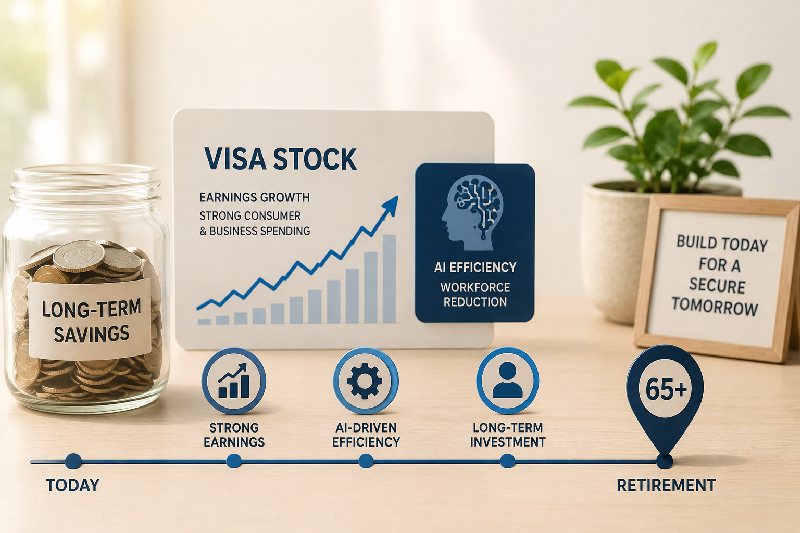
Visa is cutting thousands of jobs while reporting another quarter of strong revenue and payment growth. That combination can seem confusing. Layoffs often sound like a warning sign, but companies also reduce staff when they want to lower costs, redirect spending, or automate more work.
For consumers, the main question is whether these changes affect Visa cards, rewards, security, or everyday purchases. For investors, the bigger issue is whether Visa can keep growing while using artificial intelligence to operate more efficiently.
The latest developments do not point to an immediate change in how cardholders use Visa. They do, however, give shareholders new information about costs, technology investment, consumer spending, and the long-term future of the payments business.
What Changed at Visa?
Visa announced plans to reduce its workforce by about 7%, or roughly 2,600 positions. The cuts are expected to fall mainly on technology and product teams, although other parts of the company may also be affected.
Management described the move as an effort to improve efficiency and redirect resources toward areas with stronger growth potential. Artificial intelligence is part of that shift, but the company has indicated that AI is not the only reason for the reductions.
The announcement came as Visa reported strong results for its fiscal third quarter of 2026. Net revenue rose 14% from the prior-year period to about $11.6 billion. Adjusted earnings reached $3.32 per share, while payment volume increased approximately 10% and cross-border volume rose about 13%.
| Latest development | Why it matters |
|---|---|
| About 2,600 planned job cuts | May lower expenses but could also create execution and employee-morale risks. |
| Net revenue up 14% | Shows continued growth in Visa’s payment network. |
| Adjusted earnings of $3.32 per share | Provides a measure of profit allocated to each share after certain adjustments. |
| Payment volume up about 10% | Suggests consumers and businesses continued spending through Visa’s network. |
| Cross-border volume up about 13% | Points to strength in international spending and travel-related transactions. |
Why Would a Profitable Company Cut Jobs?
A company does not have to be losing money before it reduces its workforce. Large businesses regularly review which teams, products, and projects are producing the best returns.
Visa may be able to automate repetitive work, shorten product-development cycles, and consolidate certain technical functions. Savings from those changes can then be redirected toward areas such as fraud detection, stablecoin services, business payments, cross-border transactions, and AI-powered commerce.
Investors should not automatically view layoffs as either good or bad. Cost reductions can improve profits, but the result depends on how they are carried out.
If Visa cuts roles without weakening customer service, security, innovation, or relationships with banks and merchants, the restructuring could improve efficiency. If the cuts slow product development or create operational problems, the savings may not be worth the damage.
What the Job Cuts Mean for Visa Employees and the Broader Job Market
The most direct personal finance effect falls on the employees losing their jobs. A layoff can affect income, health insurance, retirement contributions, housing decisions, and emergency savings.
Visa’s decision also matters beyond its own workforce. Technology and product employees at other financial companies may see it as another sign that employers are changing the skills they value. Roles involving routine analysis, coding support, documentation, and basic product processes may become more automated.
At the same time, demand may grow for employees who can build AI systems, manage data, prevent fraud, supervise automated decisions, and connect new technology to real payment products.
Workers in the payments or financial-technology industries may want to focus on skills that remain difficult to automate. These include cybersecurity, regulatory knowledge, product strategy, risk management, complex client support, and AI oversight.
Do the Changes Affect Visa Cardholders?
For most consumers, the immediate answer is no. Visa usually does not issue the credit card, set the interest rate, decide the annual fee, or create the rewards program. Those decisions are generally made by the bank or credit union whose name appears on the card.
Visa operates the payment network that helps move transaction information between consumers, merchants, and financial institutions.
That means Visa’s workforce reduction does not automatically change:
- Your credit limit
- Your card’s annual percentage rate
- Your minimum payment
- Your rewards rate
- Your annual fee
- Your billing due date
- Your bank’s approval rules
Cardholders should continue contacting their issuing bank for questions about charges, rewards, payments, credit limits, or account problems.
Could Consumers Notice Indirect Effects?
Possibly, but any effect would likely develop over time. Visa is investing in fraud prevention, tokenized payments, contactless transactions, AI tools, and new ways for software agents to make purchases.
Better technology could reduce fraud, speed up payment processing, and improve transaction approvals. However, more automation also raises concerns about privacy, mistaken fraud blocks, and how disputes are handled.
Consumers should keep transaction alerts turned on and review statements regularly. Even advanced fraud systems can miss unauthorized charges or incorrectly flag legitimate ones.
Why Visa’s Earnings Matter to Ordinary Consumers
Visa’s results provide a broad view of spending activity. The company earns revenue when payments move through its network, so rising payment volume can suggest that consumers and businesses are still spending.
Strong spending does not necessarily mean every household is financially healthy. Payment totals can rise because of inflation, population growth, travel, higher-income consumer activity, or increased use of cards instead of cash.
A household may be charging more because income is rising. Another household may be charging more because grocery, insurance, or utility costs are harder to cover.
Consumers should not interpret Visa’s revenue growth as a reason to spend more or carry additional credit card debt. Visa benefits from payment activity, but cardholders are responsible for the interest charged by their issuing banks.
What Cross-Border Growth Tells Investors
Cross-border transactions happen when a payment is made in a country different from where the card was issued. International travel and online purchases from foreign merchants can both contribute to this category.
These transactions are especially valuable to Visa because they often produce higher fees than domestic payments. The latest increase in cross-border volume suggests continued strength in international travel and global commerce.
Investors should watch this figure because it can be sensitive to recessions, currency movements, geopolitical disruptions, and changes in travel demand.
If consumers reduce international trips or businesses cut global spending, cross-border growth may slow even if domestic card use remains stable.
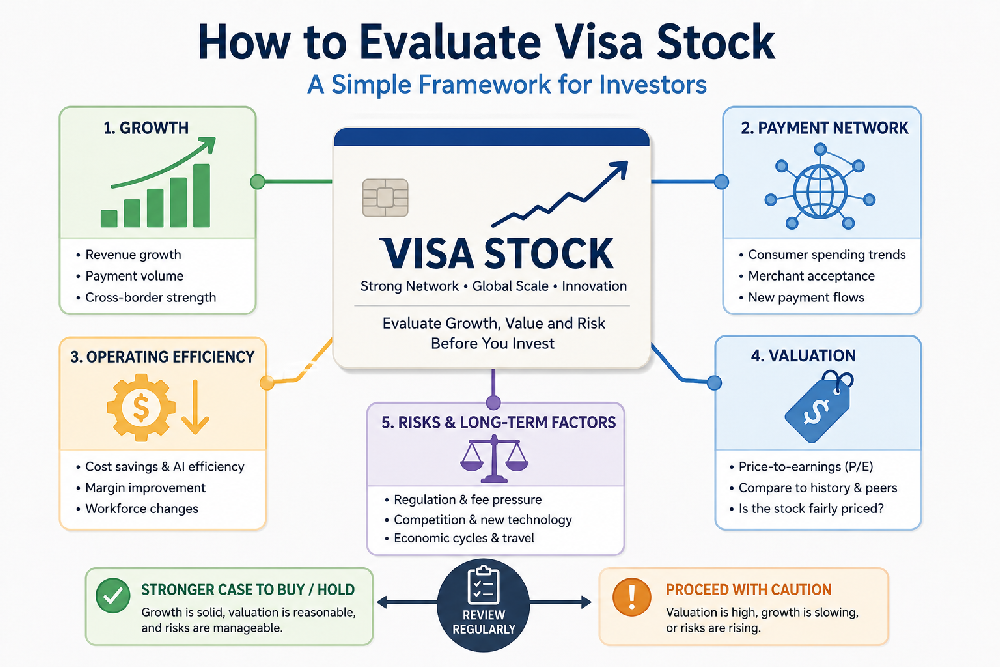
How to Evaluate Visa Stock After the Earnings Report
A strong earnings report does not automatically make a stock a good purchase. The price investors pay matters.
Visa shares had already risen before the results were released, and the stock declined in after-hours trading despite revenue and earnings coming in above expectations. This can happen when investors expected even stronger results or when a stock’s valuation already reflects a large amount of future growth.
Before buying Visa stock, consider the following questions:
| Question | What to examine |
|---|---|
| Is revenue still growing? | Compare current growth with earlier quarters and management’s long-term targets. |
| Are payment volumes healthy? | Review domestic, international, and processed transaction growth. |
| Are margins improving? | Check whether cost reductions lead to higher operating profit without hurting service. |
| Is the stock expensive? | Compare its price-to-earnings ratio with its historical range and expected growth. |
| Is Visa returning cash? | Look at dividends and share repurchases, but do not treat them as guaranteed. |
| Are new payment technologies a threat? | Monitor stablecoins, account-to-account transfers, digital wallets, and regulatory changes. |
A Simple Valuation Example
The price-to-earnings ratio, often called the P/E ratio, compares a company’s stock price with its annual earnings per share.
P/E ratio = Share price ÷ Annual earnings per share
Suppose Visa shares trade at $360 and analysts expect the company to earn $14 per share over the next year.
$360 ÷ $14 = 25.7
That would equal a forward P/E ratio of about 25.7.
A higher ratio usually means investors expect strong future growth. It can also mean the stock has less room for disappointment. If earnings grow more slowly than expected, the share price may fall even when the company remains profitable.
This calculation should be only one part of an investment decision. Investors should also examine cash flow, competition, regulation, profit margins, debt, and management guidance.
Visa’s Main Long-Term Opportunities
Visa still has several possible growth areas.
- More digital payments: Consumers continue moving away from cash in many markets.
- Cross-border travel: International transactions can generate attractive fees.
- Business payments: Many company-to-company transactions still rely on checks or bank transfers.
- Fraud and security services: Banks and merchants may pay for tools that improve transaction safety.
- AI-powered commerce: Software agents may eventually compare products and complete approved purchases for consumers.
- Stablecoin settlement: Visa may use blockchain-based payment tools while still providing network and compliance services.
The key question is whether Visa can participate in new payment systems rather than being bypassed by them.
Risks Investors Should Not Ignore
Visa has a strong network, but it is not risk-free.
Governments may regulate interchange fees or payment practices. Banks and merchants may push for lower costs. New systems may allow money to move directly between accounts without using a traditional card network. Cybersecurity failures could damage trust and lead to financial losses.
AI creates another set of risks. Automated fraud systems can make mistakes. AI-based shopping tools may change which payment method is chosen. Job cuts may also remove experienced employees needed to manage complex products and security issues.
Visa’s large size and established relationships provide advantages, but investors should not assume that past growth will continue at the same rate forever.
Should You Buy Visa Stock Now?
The latest results show a company that continues to grow, generate cash, and benefit from global payment activity. The layoffs suggest management is also trying to control costs and redirect spending toward technology and higher-growth opportunities.
That may support the long-term investment case, but the stock price still matters. A strong company can be a poor investment when purchased at an overly high valuation.
Investors who already own Visa may want to compare the position with the rest of their portfolio. Holding too much of one company creates concentration risk, even when that company is profitable.
New investors may prefer to buy gradually rather than invest a large amount immediately after an earnings announcement. Others may choose a broad index fund to gain limited exposure to Visa along with hundreds of other companies.
Frequently Asked Questions
Is Visa cutting jobs because its business is weak?
Not based on the latest earnings. Revenue and payment volumes continued to grow. The company says the reductions are intended to improve efficiency and redirect resources, although investors should monitor whether the cuts affect future performance.
Will Visa’s layoffs change my credit card rewards?
Not directly. Rewards are usually managed by the bank that issued the card. That bank can change rewards, fees, or terms according to the card agreement.
Does Visa earn credit card interest?
Visa generally earns fees from processing payments and providing network services. The issuing bank typically receives the interest charged when a consumer carries a balance.
Why did Visa stock fall after strong earnings?
Stocks can fall when good results were already expected, when the share price is expensive, or when investors are concerned about future guidance, costs, or growth. A quarterly earnings beat does not guarantee a positive stock reaction.
Are Visa’s share buybacks good for investors?
Buybacks reduce the number of shares outstanding and can increase earnings per share. They create more value when shares are repurchased at a reasonable price. Buying back overvalued stock may be less beneficial.
The Bottom Line
Visa’s latest quarter showed strong revenue, earnings, payment volume, and international spending growth. At the same time, the company is cutting about 7% of its workforce as it uses more automation and shifts spending toward higher-priority opportunities.
Cardholders do not need to change how they use their Visa cards because of the announcement. They should continue managing rewards, interest rates, and account issues through the bank that issued the card.
Investors should look beyond the headline. The layoffs may improve efficiency, but they also create execution risk. Visa remains a powerful global payment network, yet its future returns will depend on growth, competition, regulation, technology changes, and the valuation paid for the stock.
References
- Visa Investor Relations: Quarterly Earnings — Provides Visa’s official quarterly financial releases, payment-volume data, earnings materials, and management updates.
- U.S. Securities and Exchange Commission: Visa Filings — Includes Visa’s regulatory filings, risk disclosures, financial statements, and official business information.
- Reuters: Visa to Lay Off 7% of Staff — Reports the size, focus, and stated purpose of Visa’s workforce reduction.
- Visa Investor Relations: Dividends and Stock Information — Supports information about Visa’s shareholder distributions and dividend history.
- Consumer Financial Protection Bureau: Card Networks and Issuers — Explains the difference between a payment network such as Visa and the bank that issues a credit card.