
Supplemental Security Income recipients may notice something unusual on the 2026 payment calendar: an SSI payment is scheduled for Friday, July 31, but no SSI payment appears during August.
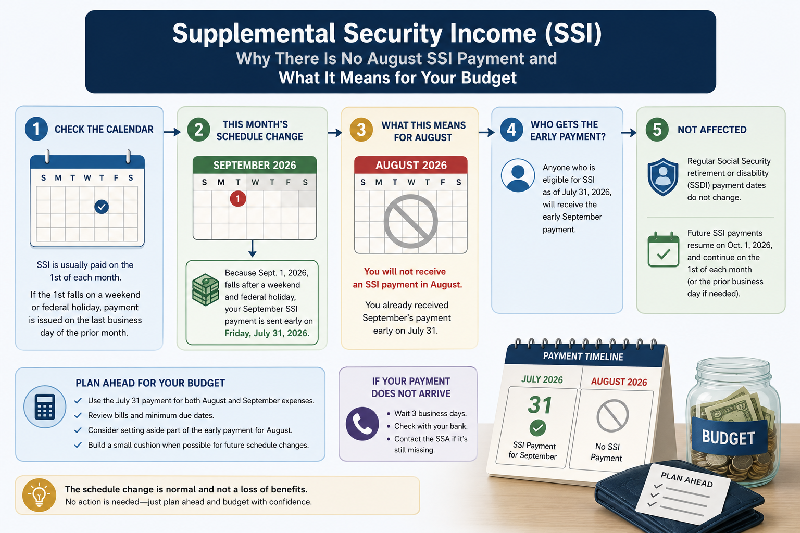
This does not mean the August benefit was canceled. It also does not mean recipients are receiving an extra payment in July. The July 31 deposit is the regular SSI payment for August, sent one day early because August 1 falls on a Saturday.
The timing can still create a real budgeting problem. A payment deposited at the end of July may need to cover rent, food, utilities, transportation, and other expenses throughout August. Understanding which month the money belongs to can help recipients avoid spending it too early or mistakenly reporting a missing payment.
Why the August SSI Payment Arrives on July 31
SSI is normally paid on the first day of each month. When the first falls on a weekend or federal holiday, the Social Security Administration generally sends the payment on the previous business day.
August 1, 2026, falls on a Saturday. Therefore, the payment that would normally arrive on August 1 is scheduled for Friday, July 31.
| Benefit Month | Normal Payment Date | Actual 2026 Payment Date | Reason |
|---|---|---|---|
| July | July 1 | July 1 | The first day of the month is a business day. |
| August | August 1 | July 31 | August 1 falls on a Saturday. |
| September | September 1 | September 1 | The first day of the month is a business day. |
The key point is simple: the July 31 deposit is August’s SSI benefit. It is not September’s payment, and it is not a bonus check.
Why Two SSI Deposits May Appear in July
Most SSI recipients will see one payment on July 1 and another on July 31. That can make July look like a two-payment month.
However, the two deposits serve different months:
- The July 1 payment is for July expenses.
- The July 31 payment is for August expenses.
The payment schedule changes only when the money arrives. It does not increase the recipient’s total annual SSI benefits.
For example, suppose a recipient normally receives $900 per month. The person may receive $900 on July 1 and another $900 on July 31. That does not provide $1,800 to spend only during July. The second $900 must cover the following month.
How to Budget the Early SSI Payment
The safest approach is to treat the July 31 deposit as unavailable for ordinary July spending. Set it aside for August bills as soon as it arrives.
A simple monthly plan could look like this:
| August Expense | Planned Amount |
|---|---|
| Rent or housing costs | $450 |
| Utilities and phone | $140 |
| Food and household supplies | $190 |
| Transportation | $70 |
| Medicine or personal expenses | $50 |
| Total | $900 |
If the full payment must remain in the same checking account, recipients can still separate it mentally or on paper. Write “August SSI” beside the July 31 deposit in a budget notebook or banking app.
Another option is to schedule August bills after the deposit arrives but before money is used for optional purchases. Automatic payments can help, but recipients should confirm the due dates and account balance to avoid overdraft fees.
A Useful Cash-Flow Calculation
Recipients can estimate how much is available for weekly spending after fixed bills are covered.
Monthly SSI payment − fixed monthly bills = money available for flexible expenses
Then divide the remaining amount by the number of weeks it must cover.
Using the $900 example:
$900 − $640 in fixed bills = $260 remaining
If the $260 must last about four weeks:
$260 ÷ 4 = $65 per week
This does not create more money, but it can make the early payment easier to manage throughout August.
Does the Schedule Change Affect Regular Social Security Payments?
The July 31 SSI payment does not automatically change the schedule for regular Social Security retirement, survivors, or disability benefits.
Many Social Security payments are issued on the second, third, or fourth Wednesday of the month, based on the beneficiary’s birth date. Different rules may apply to people who began receiving Social Security before May 1997 or who receive both Social Security and SSI.
Someone who receives both programs may therefore see an SSI deposit on July 31 and a separate Social Security payment during August. Those are different benefits and should not be confused with each other.
Recipients should check their own benefit notice or online account rather than relying on another person’s payment date. Two people in the same household may receive benefits on different days.
What If the July 31 Payment Does Not Arrive?
First, check whether the payment was issued by direct deposit, deposited onto a Direct Express card, or sent through another approved payment method.
Recipients should also review their bank account carefully. A deposit may appear under a shortened federal payment description rather than the words “Supplemental Security Income.”
The Social Security Administration advises recipients to allow additional mailing days before contacting the agency when a payment does not arrive on the expected date. For electronic payments, recipients can also contact their bank or card provider to determine whether a deposit is pending.
Before contacting Social Security, gather:
- The expected payment date
- The last four digits of the account receiving the payment
- Recent bank or Direct Express transaction information
- Any notice from Social Security about a benefit change
Never provide a full Social Security number, bank password, or account PIN to an unexpected caller or text sender. A message claiming that a payment must be “released” after paying a fee is a warning sign of a scam.
Could the July 31 Deposit Affect SSI Resource Limits?
SSI has strict income and resource rules, so an early deposit may cause concern when it remains in an account at the end of July.
In general, an early SSI payment is intended for the following month and is not treated as an extra July benefit simply because it arrives before August begins. However, recipients should keep clear bank records showing the deposit date and payment source.
People who are already near the SSI resource limit should avoid moving money between accounts without understanding how the transfer may appear. They may also want to keep their award notices and monthly statements in case Social Security asks about the account balance during a review.
Questions involving trusts, joint accounts, inherited funds, gifts, or large account balances can be more complicated. A qualified benefits counselor or Social Security representative can provide guidance based on the recipient’s individual situation.
Recent SSI Program Improvements
The Social Security Administration announced several administrative improvements in July 2026. These efforts focus on reducing payment errors, improving service, and making wage and financial information easier to verify.
One change involves wider use of the Access to Financial Institutions tool. This system helps Social Security verify financial accounts and identify possible overpayments earlier.
The agency also reported full implementation of the Payroll Information Exchange. This system can provide more timely wage information, which may reduce the burden on some recipients and help prevent benefit amounts from being calculated using outdated earnings data.
Social Security is also updating policy instructions, using new technology to direct calls more effectively, and strengthening nonmedical eligibility reviews. During these reviews, the agency may confirm income, resources, living arrangements, and other factors that affect SSI eligibility.
These improvements do not mean every recipient will receive a higher payment. They may instead affect how quickly information is processed and how accurately payments are calculated.
How to Prepare for an SSI Review
Recipients can reduce delays by keeping important records organized. Useful documents may include:
- Recent bank statements
- Pay stubs or wage records
- Rent receipts or lease documents
- Proof of household expenses
- Information about changes in living arrangements
- Notices involving pensions, disability benefits, or other income
Report important changes promptly. Waiting too long to report wages, household changes, or new financial resources can lead to an overpayment. An overpayment occurs when Social Security sends more money than the recipient was eligible to receive. The agency may later seek repayment.
Frequently Asked Questions
Is SSI being skipped in August 2026?
No. The August SSI payment is scheduled to arrive early on July 31 because August 1 falls on a Saturday.
Is the July 31 payment an extra SSI check?
No. It is the regular August payment. Receiving two deposits during July does not increase the total amount of annual SSI benefits.
Will the September SSI payment also arrive in July?
No. The official schedule lists the September SSI payment for September 1, 2026.
Will Social Security retirement payments stop in August?
No. The SSI calendar change does not cancel regular Social Security retirement, disability, or survivors payments. Those benefits follow their own schedules.
What should I do with the July 31 deposit?
Reserve it for August expenses. Consider paying essential August bills first and dividing the remaining amount into weekly spending limits.
What is the maximum federal SSI payment in 2026?
The maximum monthly federal amount is $994 for an eligible individual and $1,491 for an eligible couple. Actual payments may be lower because of income, living arrangements, state supplements, or other eligibility factors.
Final Takeaway
The missing August date on the SSI calendar is a timing change, not a loss of benefits. August’s payment is scheduled for July 31 because the normal payment date falls on a Saturday.
Recipients should label the early deposit as August money and protect it from being spent during July. A written plan, scheduled bill payments, and weekly spending limits can make the longer gap until September 1 easier to manage.
Recent SSI administrative changes may improve wage reporting, account verification, and payment accuracy, but recipients still need to report important financial and household changes. Keeping records and checking official Social Security notices remain the best ways to prevent confusion and avoid overpayments.
References
- Social Security Administration: Schedule of Social Security Benefit Payments for 2026 — Confirms the July 31 SSI payment date, the absence of a separate August deposit, and the September 1 payment date.
- Social Security Administration: Payment Calendar — Provides official current and upcoming calendars for SSI and Social Security benefit payments.
- Social Security Administration: SSI Federal Payment Amounts for 2026 — Supports the 2026 maximum federal SSI amounts for individuals and eligible couples.
- Social Security Administration: Improvements in the SSI Program — Describes recent changes involving wage reporting, financial verification, service, and payment accuracy.
- Social Security Administration: Supplemental Security Income — Provides official information about SSI eligibility, applications, payments, and reporting responsibilities.